AI Powered Summary
AI Powered Summary
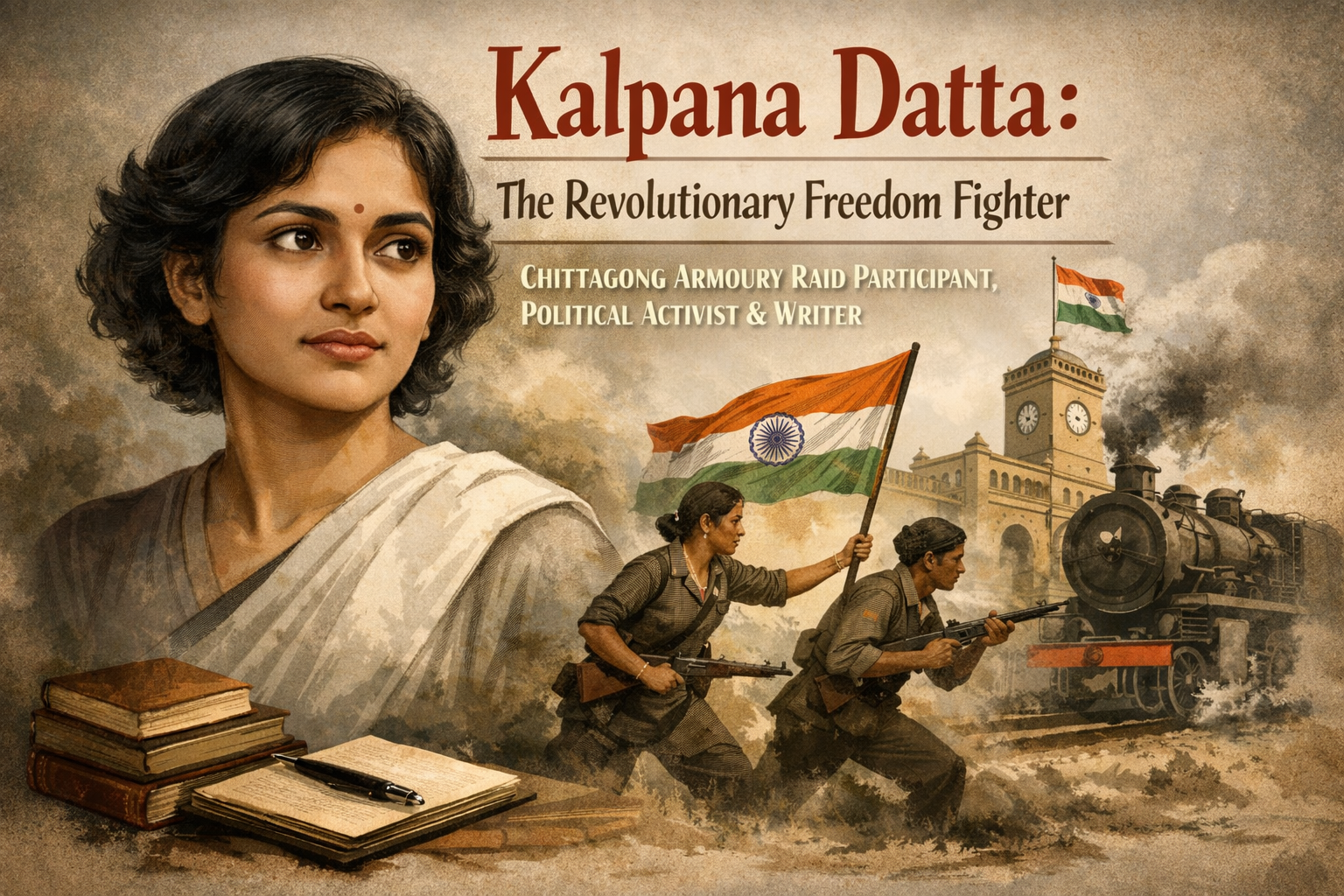
Kalpana Datta, later known as Kalpana Joshi, was one of the most remarkable women of India’s freedom movement. Born on 27 July 1913 and remembered as a revolutionary, political activist, writer and public intellectual, she belonged to that generation of young Indians who did not merely dream of independence but were willing to risk imprisonment, exile and death for it. Her life moved through several distinct phases: student activism, underground revolutionary work, participation in the anti-colonial armed struggle in Chittagong, imprisonment under British rule, later association with the communist movement, and finally a long intellectual and institutional life after independence.
She is most widely remembered for her connection with the Chittagong Armoury Raid movement led by Surya Sen, one of the most dramatic episodes in the history of anti-British resistance in eastern India. But Kalpana Datta’s life cannot be reduced to one event. She was part of a broader generation of women who stepped far beyond the social expectations of their time. They entered underground politics, handled secrecy and surveillance, undertook dangerous missions, built nationalist networks, and helped redefine the idea of women’s participation in India’s freedom struggle.
Her story is also important because it connects several histories at once. It belongs to the history of the revolutionary movement in Bengal, the history of women in anti-colonial resistance, the history of Chittagong as a major centre of militant nationalism, and the later history of left political engagement in India. Kalpana Datta’s life shows that the freedom movement was never one single stream. Alongside constitutional politics, peasant struggles, civil disobedience campaigns and labour movements, there was also an armed revolutionary tradition shaped by secrecy, sacrifice and relentless courage.
Early Life and Family Background
Kalpana Datta was born in Sripur, a village in the Chittagong District of the Bengal Presidency, in a region that now lies in Boalkhali Upazila, Bangladesh. She was born into a Bengali family during a time when the political atmosphere of Bengal was already charged with anti-colonial feeling. The Bengal Presidency had long been one of the most politically active regions under British rule, and it had produced reformers, nationalists, revolutionaries, writers and student activists in large numbers.
Her father, Binod Behari Dattagupta, was a government employee. Like many families of the period, hers existed within the contradictions of colonial India: formal employment could be linked to the administrative world of British rule, yet the emotional and political climate of educated Bengali society was increasingly turning toward nationalism. That setting is important because many young revolutionaries of the time came not from isolated margins but from households that valued education, discipline and ambition, even while living under colonial structures.
Kalpana Datta’s upbringing gave her access to education and public awareness at a time when women’s political participation was still constrained by social custom. Yet Bengal, and especially urban-intellectual circles connected to anti-colonial currents, offered more openings than many other regions. By the time she came of age, women in Bengal had already begun to enter student politics, nationalist mobilization and underground networks. Kalpana would become one of the most fearless among them.
Education and the Formation of a Revolutionary Mind
Like many politically awakened young women of her generation, Kalpana Datta’s early years of education coincided with a period of rapidly rising nationalist sentiment. Across Bengal, students were increasingly exposed not only to textbooks and examinations but to public debate about swaraj, civil disobedience, sacrifice and anti-colonial resistance. The influence of the Non-Cooperation Movement, revolutionary literature, political speeches and student organizations was profound.
Her political development was not sudden. It emerged through association, reading, observation and organizational contact. The transition from student life to revolutionary commitment was a major step, especially for women in that period. It required crossing social boundaries as much as political ones. A young woman entering semi-secret nationalist activity had to challenge not only colonial power but also expectations about gender, family reputation and acceptable public behavior.
Kalpana Datta eventually became associated with Chhatri Sangha, described as a semi-revolutionary women’s student organization. This was a crucial stage in her life. Chhatri Sangha was important not merely as a student grouping but as a network through which politically minded young women came into contact with nationalist and revolutionary currents. It helped create a space where women could think of themselves not only as supporters of male-led politics but as actors in their own right.
She was associated in that context with names such as Bina Das and Pritilata Waddedar, both of whom occupy an important place in the history of militant anti-colonial activism in Bengal. The presence of such figures reminds us that Kalpana Datta belonged to a wider cohort of women who refused passive roles in the freedom struggle.
Chittagong and the Revolutionary Underground
To understand Kalpana Datta’s life fully, one must understand the political importance of Chittagong. Located in eastern Bengal, Chittagong was both a port city and a strategic colonial centre. It housed administrative structures, communication lines and armories important to British rule. For revolutionaries, it presented both a challenge and an opportunity. A strike against British authority in Chittagong could be both practical and symbolic.
The revolutionary movement there came under the leadership of Surya Sen, remembered widely as Masterda Surya Sen. He was one of the most iconic revolutionary figures of the Bengal anti-colonial struggle. A schoolteacher by profession, he became the organizer and moral centre of a network of young men and women committed to armed resistance against British rule. His appeal lay not only in courage but in discipline, planning and his ability to inspire youth.
Kalpana Datta became a member of this revolutionary stream and participated in the broader movement that grew around the Chittagong Armoury Raid of 1930. This act of anti-colonial militancy aimed to strike directly at British authority by attacking armouries, disrupting communications and symbolically proclaiming the collapse of colonial control in the area. Though the operation did not produce lasting military success, it achieved immense historical significance by demonstrating the seriousness, organization and sacrifice of revolutionary youth.
[awps]
The Chittagong Armoury Raid and Its Meaning
The Chittagong Armoury Raid of April 1930 remains one of the most dramatic revolutionary actions in India’s freedom movement. The plan involved seizing British armouries, cutting communication links and disrupting the colonial administration’s ability to respond quickly. It was not merely an outburst of anger. It was a coordinated act, shaped by planning and intended to inspire a wider uprising against British rule.
Kalpana Datta is remembered as a participant in this movement, though like many women revolutionaries, her exact operational role has sometimes been overshadowed by broader narratives centred on male leaders. Yet her presence matters deeply. She was not a symbolic figure attached afterward to the story. She was part of the revolutionary world that sustained the movement through secrecy, mobility, risk and loyalty.
The raid itself occupies a special place in history because it represented a different mode of anti-colonial politics from Gandhi’s mass nonviolent movements. It belonged to the revolutionary tradition that believed British imperialism would not collapse under moral appeal alone and that direct armed challenge had a place in the struggle. Whether one agrees with that strategy or not, it clearly produced men and women of extraordinary courage, and Kalpana Datta was one of them.
Joining the Armed Resistance
According to the information in the source image, Kalpana Datta formally joined the armed resistance in May 1931. By this point, the Chittagong revolutionary struggle had already entered a dangerous and repressive phase. The British had intensified surveillance, arrests and punitive action. To join the underground at such a time was not an impulsive gesture. It was a commitment to a life of constant danger.
She was later tasked, along with Pritilata Waddedar, to attack the European Club in Chittagong. That target had symbolic importance because the European Club represented racial colonial privilege and exclusion. Clubs of this kind were not merely social spaces; they were part of the architecture of imperial hierarchy, marking a world in which the rulers lived apart from the ruled.
The association of Kalpana Datta with such plans demonstrates the seriousness of her role. Women in the revolutionary underground were not simply messengers or supporters. They also participated in planning, evasion, transport and, when necessary, direct action. Their very mobility sometimes helped them avoid initial suspicion, although once identified by the police, they faced the same brutal consequences as men.
Life Underground and the Risks of Revolutionary Work
Revolutionary activity under British rule demanded a life of secrecy. Members of underground groups changed locations frequently, relied on safe houses, communicated cautiously and lived under the constant threat of informers, police raids and arrest. For women, these dangers were layered with additional risks. Moving alone, appearing in politically suspicious company or leaving conventional domestic settings could immediately draw notice in a conservative social environment.
Kalpana Datta’s revolutionary life must therefore be understood not only in terms of ideology but in terms of personal endurance. To remain underground meant living with uncertainty every day. Arrest could bring imprisonment, torture, transportation for life or execution, depending on the charges and the mood of the government. Yet despite this, she continued in the struggle.
One of the clearest examples of this danger came on 16 February 1933, when the police encircled a hideout in Gairala village. During this crackdown, Surya Sen was arrested, but Kalpana Datta managed to escape. This episode captures both the fragility and the resilience of underground networks. One arrest could destroy an organization, yet the ability of some members to evade capture allowed the movement’s memory and spirit to survive.
Attempt to Free Surya Sen
After Surya Sen’s arrest, Kalpana Datta attempted to bomb the jail in an effort to free him, but the attempt failed. This episode is striking because it reveals the intensity of loyalty and commitment within the revolutionary group. Surya Sen was not only a leader; he was the movement’s moral and organizational centre. To rescue him was not just a personal desire but an attempt to keep alive the possibility of continued resistance.
The failed attempt also shows the practical limitations under which revolutionaries operated. Courage alone was not enough. They faced a far stronger state with more weapons, more surveillance capacity and more legal power. Yet the willingness to attempt such a rescue underlines the extraordinary determination that defined Kalpana Datta’s political life in those years.
Arrest and Trial
Kalpana Datta was finally arrested on 19 May 1933. By then, the British authorities had already committed themselves to crushing the Chittagong revolutionary movement through arrests, trials and exemplary punishments. Her arrest marked the end of one phase of her life but not the end of her historical importance.
She was later tried in the second supplementary trial of the Chittagong Armoury Raid case. These trials were part of the British colonial state’s strategy of making an example out of revolutionaries. The goal was not simply to punish individuals but to break networks, intimidate supporters and publicly reaffirm imperial authority.
In that trial, Kalpana Datta was sentenced to transportation for life. This was among the harshest punishments available short of execution. Transportation, in the colonial legal imagination, meant removal, isolation and the destruction of ordinary civil life. The sentence reflected how seriously the British regarded the Chittagong revolutionaries and how threatening they considered figures like Kalpana Datta.
Release in 1939
Despite the severity of the sentence, Kalpana Datta was released in 1939. Her release came during a changing political atmosphere, as nationalist pressure, public opinion and broader shifts in colonial politics influenced how some political prisoners were treated. Even so, the years between arrest and release were formative. Prison did not erase her politics. It deepened the authority of her experience.
Many revolutionaries emerged from prison physically damaged but intellectually sharpened, carrying with them memories that would later shape writings, speeches and political choices. Kalpana Datta was among those who transformed lived struggle into historical testimony.
From Revolutionary Nationalism to Communist Politics
After her release, Kalpana Datta’s political journey moved into a new phase. She later joined the Communist Party of India, indicating a shift from underground anti-colonial militancy to organized left politics within a broader ideological framework. This transition was not unusual among former revolutionaries. Many who had fought British rule through armed or semi-armed methods later found in socialist and communist politics a framework for understanding inequality, labour, class and the unfinished tasks of freedom.
Her marriage in 1943 to Puran Chand Joshi, who was the general secretary of the Communist Party of India, further connected her life to the organized left movement in India. Under the name Kalpana Joshi, she became part of an intellectual and political world that extended beyond anti-colonial resistance into debates about nation-building, class politics, culture and modern India.
This later phase of her life is significant because it shows continuity rather than rupture. The revolutionary impulse of her youth did not disappear. It evolved. Her commitment remained tied to justice, collective struggle and public life, even if the forms of organization changed.
Writer and Chronicler of Chittagong
Kalpana Datta also holds an important place as a writer of memory. She wrote an autobiographical book in Bengali, titled Chattagram Astragar Luntankari Der Smritikatha. The work later became available in English translation as Chittagong Armoury Raiders: Reminiscences, translated by Arun Bose and Nikhil Chakraborty, with a preface by P. C. Joshi.
This literary contribution matters enormously. Much of revolutionary history risks becoming flattened into heroic slogans unless participants leave behind reflective testimony. Kalpana Datta’s reminiscences helped preserve the texture of revolutionary life: its danger, idealism, personal relations, losses and political atmosphere. Such writing is historically invaluable because it gives voice not just to events but to consciousness.
Her Bengali book was first published in January 1946. The date is important. India had not yet become independent. The memory of revolutionary struggle was still politically alive. To publish such reflections at that time was to intervene in the nation’s understanding of its own liberation movement.
Work at the Indian Statistical Institute
Later in life, Kalpana Datta joined the Indian Statistical Institute, where she worked until retirement. This phase of her life may appear quieter than her years in the underground, but it is no less revealing. It shows how many former freedom fighters moved into institutions of modern India, contributing to the intellectual and administrative life of the country after independence.
The Indian Statistical Institute was one of the important research institutions of modern India, and her association with it suggests a life that was not confined to memory or ceremony. She continued to participate in the evolving public world of independent India, carrying with her the legacy of anti-colonial struggle while living within the structures of a postcolonial nation.
Personal Life and Family Connections
Kalpana Datta’s marriage to Puran Chand Joshi linked her to one of the most important left political figures of twentieth-century India. The source image also notes Chand Joshi (1946–2000), identified as a prominent journalist and author of Bhindranwale: Myth and Reality (1984). This detail reflects how Kalpana Datta’s personal life was connected to a wider intellectual and political family environment.
That continuity across generations is notable. Her life began in revolutionary underground politics and later became connected to journalism, public debate, intellectual labour and institutional India. In this sense, she belongs not only to the history of anti-colonial action but also to the longer history of politically engaged Indian public life.
Death and Historical Memory
Kalpana Datta died in Calcutta on 8 February 1995. By the time of her death, India had long been independent, but the memory of the freedom struggle remained central to public life. Yet many women revolutionaries still did not receive the level of popular recognition given to more widely commemorated male figures. This makes Kalpana Datta’s remembrance especially important.
Her life stands as a reminder that the freedom struggle was never the work of a few famous leaders alone. It was sustained by hundreds and thousands of individuals, many of them very young, many of them women, many of them willing to disappear into secrecy, prison or obscurity for a cause larger than themselves. Kalpana Datta was one of those figures whose courage deserves a much larger place in India’s public memory.
Why Kalpana Datta Matters Today
Kalpana Datta matters today for several reasons. First, she represents the role of women in the revolutionary wing of India’s freedom movement, a subject that is still less widely known than it should be. Second, her life shows the diversity of the nationalist struggle. India’s freedom did not come through one method alone; it involved constitutionalists, satyagrahis, underground revolutionaries, workers, peasants, students and intellectuals. Kalpana belongs to that larger mosaic.
Third, her autobiographical writing gives her a special place as both participant and witness. She did not merely act in history; she also helped record it. That dual role makes her particularly valuable to future generations trying to understand the emotional and political worlds of anti-colonial resistance.
Finally, her life challenges simplistic narratives about women in public life. She was not only brave in a symbolic sense. She took risks, escaped raids, faced trial, endured sentencing, entered organized politics and preserved memory through writing. She represents agency in its fullest form.
Frequently Asked Questions About Kalpana Datta
Who was Kalpana Datta?
Kalpana Datta, later known as Kalpana Joshi, was an Indian independence activist, revolutionary associated with the Chittagong Armoury Raid movement, writer and later political figure linked to the Communist Party of India.
When was Kalpana Datta born?
She was born on 27 July 1913.
Where was Kalpana Datta born?
She was born in Sripur in the Chittagong District of the Bengal Presidency, in a place now located in Boalkhali Upazila, Bangladesh.
What was Kalpana Datta’s role in the freedom movement?
She was a member of the revolutionary movement led by Surya Sen, participated in the Chittagong revolutionary struggle, joined the armed resistance, faced arrest and life transportation, and later recorded her experiences in writing.
Was Kalpana Datta part of the Chittagong Armoury Raid movement?
Yes. She was associated with the revolutionary movement connected to the Chittagong Armoury Raid and later faced trial in the second supplementary proceedings related to that case.
When was she arrested?
She was finally arrested on 19 May 1933.
What punishment did she receive?
She was sentenced to transportation for life in the second supplementary trial of the Chittagong Armoury Raid case.
When was Kalpana Datta released?
She was released in 1939.
What did Kalpana Datta write?
She wrote an autobiographical book in Bengali, later translated into English as Chittagong Armoury Raiders: Reminiscences.
When did Kalpana Datta die?
She died in Calcutta on 8 February 1995.
Kalpana Datta’s life remains one of the most compelling stories of courage in the Indian freedom movement. She was young when she entered politics, fearless when she entered the underground, steadfast when she faced imprisonment, thoughtful when she turned memory into literature and committed when she entered public life in later years. To remember her is not only to honour one revolutionary woman. It is to recognize the breadth of India’s struggle for freedom and the many forms of sacrifice that made independence possible.
• Kalpana Datta (1913–1995), later known as Kalpana Joshi, was a revolutionary freedom fighter associated with the Chittagong Armoury Raid movement led by Surya Sen.
• She joined the revolutionary underground in the early 1930s and participated in anti-colonial armed resistance against British rule.
• Kalpana Datta was arrested in 1933 and sentenced to transportation for life, but she was later released in 1939.
• After her release, she joined the Communist Party of India and later married Puran Chand Joshi, becoming active in political and intellectual life.
• She also documented her experiences in the book “Chittagong Armoury Raiders: Reminiscences,” preserving the history of the revolutionary movement.