
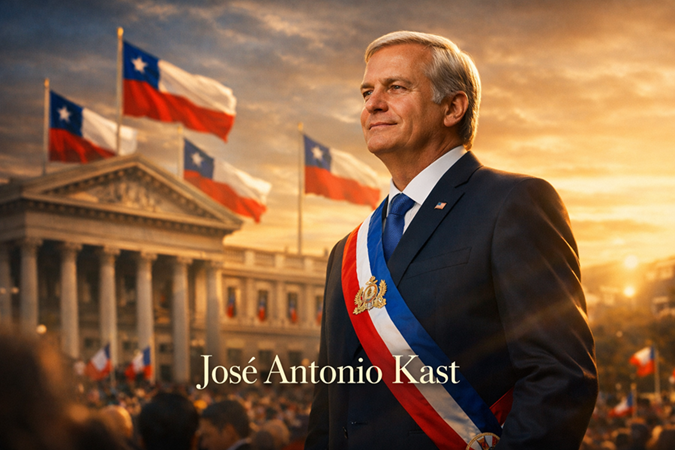
Kast reached the presidency after winning Chile’s December 2025 runoff election by a commanding margin, defeating Jeannette Jara with about 58 percent of the vote according to widely reported results. That win gave him a clear electoral mandate, but it did not remove the practical challenge of governing in a system where Congress remains a major arena of negotiation. The election itself followed a closely watched campaign season shaped by questions that had become central to Chilean public life over the past several years: public security, economic momentum, migration management, institutional effectiveness, and the pace of investment. By the time he took office, Kast was no longer speaking as a candidate promising change from the outside, but as the person now responsible for converting campaign priorities into legislation, administration, and measurable outcomes.
The swearing-in ceremony in Valparaíso was republican and ceremonial in tone, but the political meaning was larger than symbolism. Chile has a long democratic tradition and a closely observed constitutional order, so inaugurations matter not only as moments of transfer but as demonstrations of continuity in state institutions. The official Chilean government description of the event framed it as the start of the new constitutional period, while international coverage highlighted the high level of global attention around the ceremony. Heads of state, foreign delegations, and international guests were present, underscoring that Chile’s leadership transition was being watched in diplomatic, business, and policy circles alike. The visual image was familiar to Chilean democracy: a presidential oath, the assumption of the sash, a cabinet ready to begin work, and a state apparatus preparing for a new policy direction without interruption to institutional order.
In his first address as president, Kast signaled an administration that intends to move quickly on security, border management, audits of government operations, and measures aimed at restoring business confidence and economic growth. Reuters reported that he described his incoming administration as an “emergency government,” a phrase that drew attention because it encapsulated how his team wanted the opening phase of the presidency to be understood: as a period of urgent executive action focused on organized crime, public-service performance, and the financial condition of the country. Among the early items on the administration’s policy calendar, Reuters reported, was a tax reform proposal planned for April, with an emphasis on lowering business taxes and promoting job creation. That matters because investors, domestic firms, and households will judge the new government not just by rhetoric, but by whether it can pair political messaging with workable measures that improve growth, employment, and confidence.
To understand why the new presidency immediately became an international business and policy story, it is necessary to look at Chile’s weight in the regional and global economy. World Bank data place Chile’s 2024 GDP at about $330.27 billion, with GDP per capita at roughly $16,709.9. The same World Bank data set shows GDP growth of 2.6 percent in 2024, inflation of 4.3 percent in 2024, and unemployment at 9.0 percent in 2025. Those numbers tell an important story. Chile is not a small or marginal market in the Latin American context. It is a middle-sized, upper-income economy with strong institutional visibility, high external trade exposure, and a level of macroeconomic credibility that often turns Chile into a reference point in regional economic discussion. For any new president, that means expectations come from multiple directions at once: households want relief from living-cost pressure, businesses want stable rules and stronger growth, investors want predictability, and international partners want clarity on trade, mining, and strategic sectors.
The broader near-term economic picture is similarly important. The OECD’s latest outlook for Chile projects real GDP growth of 2.4 percent in 2025 and 2.2 percent in 2026 and 2027, while also expecting inflation to continue declining toward the central bank’s 3 percent target in 2026. That outlook suggests Chile entered the new presidency with a base of relative macroeconomic stability, but not with the kind of fast expansion that automatically solves fiscal or social pressures. Growth that is steady but moderate can ease pressure, yet it also raises the bar for policy execution. A government elected on promises of stronger activity and better public order must show that it can accelerate investment without destabilizing public finances, and improve confidence without losing sight of inflation, employment, or legislative constraints. In practical terms, that means the first year of the Kast administration is likely to be evaluated closely through budget signals, reform sequencing, and the reaction of key sectors such as mining, construction, energy, transport, and retail.
No sector illustrates Chile’s strategic importance more clearly than mining. According to the U.S. Department of Commerce’s country commercial guide, Chile is the world’s top copper producer, accounting for around 24 percent of global copper production, and the world’s second-largest producer of lithium, with about 27 percent of global lithium production. The same guide notes that mining contributed around 12 percent of Chile’s GDP in 2023 and represented 57 percent of total exports, while copper output reached 5.5 million tons in 2024. It also notes that 36 percent of the world’s lithium reserves are located in Chile. These are not merely sectoral statistics. They explain why every Chilean administration is watched closely by global manufacturers, commodity traders, automakers, battery producers, energy strategists, and governments concerned with supply-chain resilience. A presidency in Chile has domestic consequences first, but it also intersects directly with world markets.
That global relevance was visible almost immediately after the inauguration. Reuters reported that Chile and the United States signed a joint statement on March 12 to begin discussions on cooperation around rare earths and other critical minerals. The talks were aimed at strengthening supply chains for materials used in electric vehicles, semiconductors, defense systems, and electronics. In the context of the energy transition and the strategic competition over industrial inputs, that development was one of the first concrete signals that the new administration would be stepping into a much larger economic conversation than national politics alone. Chile already occupies a pivotal place in the critical-minerals map because of copper and lithium, and any new alignment, exploration initiative, financing framework, or recycling partnership will be watched for its commercial implications as much as its diplomatic significance.
The makeup of the incoming cabinet also offered an early window into the administration’s governing style. Reuters reported in January that Kast appointed economist Jorge Quiroz as finance minister and named Daniel Mas to lead the mining ministry while also taking charge of a newly created economic development portfolio. Those appointments were widely interpreted as signals that the government intended to place growth, regulation, investment climate, and job creation at the center of its opening message. In a country where mining revenue, capital expenditure cycles, and external conditions can shape the national mood, the finance and mining teams are especially important. Their credibility matters to investors, to Congress, to the business community, and to ordinary citizens who ultimately judge economic policy through employment, wages, inflation, and the cost of living rather than through speeches or market commentary.
At the same time, Chile’s new government is beginning its term in a demanding external environment. Reuters noted ahead of the inauguration that global market turbulence linked to war-related shocks had complicated the economic backdrop. Chile’s exposure to copper exports means it benefits when global metals demand is strong, but its dependence on imported oil leaves it vulnerable when energy prices rise. That mix can create policy tension. Higher commodity prices may support export earnings, yet imported fuel pressure can feed inflation and weigh on households and business costs. For the new administration, that means domestic policy goals will be shaped partly by forces outside Chile’s borders: commodity cycles, energy prices, global growth, shipping conditions, financial sentiment, and the pace of the clean-energy transition. In other words, the presidency begins at a moment when international economics can quickly amplify or constrain local policy choices.
Politics inside Chile will matter just as much as the external backdrop. Reuters reported after the November parliamentary vote that Kast’s Republican Party made strong gains in both chambers of Congress but fell short of outright majorities, meaning the new administration would need allies to pass major reforms. That is a central point for understanding the months ahead. A presidential victory can create momentum, but governance in Chile still depends on coalition-building, bargaining, legislative drafting, and institutional pacing. The durability of the new government’s agenda will therefore depend not only on public approval, but also on its ability to persuade lawmakers, manage allies, and sequence reforms in a way that keeps its coalition intact while broadening support where possible. That is particularly true for tax, regulatory, security, and administrative measures that require sustained legislative backing.
Security and migration formed a major part of the political background to the election and continue to shape the early profile of the new administration. Reuters and AP both reported that public concern over crime and migration played an important role in the electoral climate that brought Kast to office. AP also reported that Chile’s foreign population had roughly doubled between 2017 and 2024 and that the country had more than 300,000 undocumented immigrants. Those figures matter because they explain why border policy, public safety, and institutional enforcement became central campaign issues and remain central governing issues. For a government that has explicitly framed order and security as early priorities, the real test will be whether policy implementation is seen as effective, lawful, and administratively sustainable over time. That is where campaign language ends and state capacity begins.
Beyond the immediate politics, Chile’s transition deserves attention because it arrives at a time when the country is trying to balance continuity and change. Chile still carries the weight of being one of Latin America’s most closely watched economies, yet it also faces the same pressures confronting many democracies: demands for faster services, safer communities, stronger wages, lower costs, and clearer long-term direction. Kast’s inauguration matters because it begins a fresh attempt to answer those demands through a new governing formula. Whether that formula succeeds will depend on several measurable things that readers can watch over the next year: the content of the tax bill, the speed of investment approvals, the tone of relations with Congress, the performance of inflation and employment, the progress of mining and infrastructure projects, and the government’s ability to show results on security without disrupting economic confidence or administrative continuity.
For readers looking for the simplest way to understand the significance of this moment, the answer is straightforward. A new president has taken office in one of South America’s most strategically important economies. He begins with a strong electoral victory, a clear public mandate on core themes, and an administration that wants to move decisively. But he also inherits a country whose performance depends on disciplined economic management, legislative negotiation, and the behavior of global markets. Chile’s next chapter will therefore be shaped not by ceremony alone, but by whether the promises made in the campaign can be translated into laws, investments, institutional delivery, and everyday improvements that citizens can actually feel.