
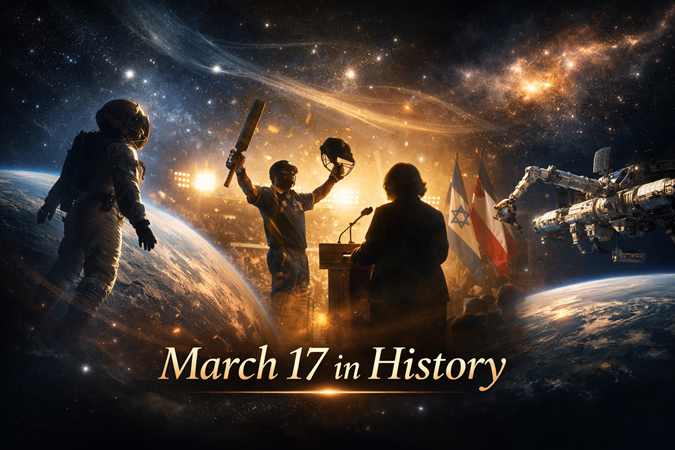
March 17 stands out in modern history for reasons that stretch across space exploration, politics, sport, science, and public policy. For many readers in India, the date is especially significant because it marks the birth anniversary of Kalpana Chawla, the Indian-born American astronaut whose life story continues to inspire students, engineers, and dreamers across the world. But March 17 also carries other notable associations: Golda Meir became Israel’s first woman prime minister on this date in 1969, Sri Lanka completed one of cricket’s most memorable title runs by winning the 1996 World Cup final, Parliament in India moved forward with the Sugar Development Fund (Amendment) Bill, 2008, the International Space Station era advanced with the deployment of the sophisticated robotic system Dextre, and the date is also linked with the widely discussed BICEP2 announcement on cosmic inflation.
What makes these events worth revisiting together is not just that they happened on or around the same date. Each of them reflects a larger story. Kalpana Chawla represents aspiration, technical excellence, and the global reach of Indian talent. Golda Meir’s elevation reflected a turning point in Israeli political history. Sri Lanka’s World Cup win changed cricket’s global hierarchy. The sugar fund amendment reflected the persistent challenge of balancing industry support with public policy. Dextre symbolized a new stage in orbital robotics. The BICEP2 episode illustrated both the excitement of scientific discovery and the self-correcting discipline of science. Taken together, these events make March 17 a rich entry point into very different parts of modern history.
Kalpana Chawla: the March 17 birth anniversary that continues to inspire generations
Kalpana Chawla was born in Karnal on 17 March 1962, and her journey from a schoolgirl in northern India to a NASA astronaut remains one of the most admired stories in the history of spaceflight. NASA’s biographical record notes that she was born in Karnal, studied at Tagore School there, earned a bachelor’s degree in aeronautical engineering from Punjab Engineering College in 1982, then completed a master’s degree in aerospace engineering in the United States in 1984 and a doctorate in aerospace engineering in 1988. Those academic steps were not merely credentials. They formed the technical foundation of a career built on discipline, advanced engineering knowledge, and a sustained commitment to flight and research.
What makes Chawla’s story so enduring is that it never feels distant or abstract. She came from an environment far removed from the launchpads and simulators of the American space program, yet she steadily made her way into one of the world’s most demanding scientific and operational institutions. She worked in aerospace research, became a pilot and flight instructor, and was selected by NASA in December 1994. After training, she moved into astronaut assignments that included technical work on robotics and shuttle software. Her career shows how spaceflight depends not only on courage, but also on years of specialization in engineering, simulation, systems work, and mission preparation.
Kalpana Chawla first flew in space on STS-87 in 1997, serving as a mission specialist and prime robotic arm operator. Britannica identifies her as the first woman of Indian origin to go to space, a milestone that gave her international recognition and made her an icon in India and across the global Indian diaspora. Her first mission was important because it placed her at the center of a major human spaceflight operation, but it was also important symbolically. For millions of students, especially girls who wanted to study science or engineering, Chawla became proof that aerospace and astronautics were not unreachable dreams.
Her second mission, STS-107, launched aboard Space Shuttle Columbia on 16 January 2003. NASA describes the mission as a dedicated 16-day multidisciplinary microgravity and Earth science research flight involving more than 80 international experiments. Chawla served as Mission Specialist 2 and flight engineer, and NASA’s memorial page records that she worked on a wide range of experiments, including biotechnology, crystal growth, combustion science, granular mechanics, and other research packages. This matters because Chawla is often remembered only through the tragedy of Columbia, but STS-107 was also a serious scientific mission. Its crew worked continuously in rotating shifts to maximize research time, reflecting how space shuttles in their later years had become major laboratories as much as transport vehicles.
The mission ended in disaster on 1 February 2003, when Columbia was lost during reentry. NASA states that the shuttle and crew were lost over East Texas about 16 minutes before scheduled touchdown. All seven crew members died. Chawla was one of them. The Columbia tragedy became one of the defining disasters in the history of the U.S. space program, leading to a long investigation, a reassessment of shuttle safety, and eventually the retirement of the shuttle fleet years later.
Yet Kalpana Chawla’s legacy has never been defined by the accident alone. Her life remains powerful because it combines technical excellence with imagination. She is remembered not only as an astronaut who flew twice and logged more than 30 days in space, but as a figure who reshaped what was conceivable for young people from ordinary backgrounds. Schools, hostels, awards, scholarships, institutions, and public memorials in India have been named after her. The Northrop Grumman Cygnus spacecraft mission launched in 2020 was named S.S. Kalpana Chawla. Her memory persists because her story still speaks clearly to ambition, preparation, and the idea that scientific achievement can begin far from the centers of power.
1969: Golda Meir became Israel’s first woman prime minister
On 17 March 1969, Golda Meir became prime minister of Israel, a landmark moment in the country’s political history. Britannica identifies her as Israel’s fourth prime minister and the first woman to hold the office. Her rise followed the death of Prime Minister Levi Eshkol in February 1969, after which she emerged as a compromise candidate who was able to unite key political forces within the ruling Labor alignment.
Golda Meir had already held several important positions before becoming prime minister. She had signed Israel’s declaration of independence in 1948, served as minister to Moscow, held cabinet positions including labour and foreign affairs, and built a reputation as one of the state’s most prominent political figures. Her premiership therefore did not begin as an isolated breakthrough. It came after years of institutional experience and public leadership.
The historical importance of March 17, 1969, lies partly in representation. Female heads of government were still rare globally at the time, and Meir’s accession became internationally notable for that reason alone. But the moment was also important in Israeli political history because it occurred during a turbulent regional period. Her years in office would later include the 1973 Yom Kippur War, making her tenure historically consequential beyond the symbolism of being first. Even so, the date itself remains especially remembered as the day Israel had its first woman prime minister.
1996: Sri Lanka defeated Australia by seven wickets to win the Cricket World Cup
For cricket fans, 17 March 1996 is inseparable from one of the sport’s great turning points. On that day, Sri Lanka defeated Australia by seven wickets in the World Cup final at Lahore to claim their first men’s ODI world title. The result remains one of the most celebrated victories in Sri Lankan sporting history and one of the most influential in the modern evolution of one-day cricket.
The official ICC overview records that Australia posted 241/7 in the final. For much of the innings, Australia appeared to be in control, but Sri Lanka pulled things back through the all-round brilliance of Aravinda de Silva, who claimed 3/42 and helped trigger a collapse after Australia had reached a strong position. Then came the chase, which sealed the match’s enduring place in cricket history. De Silva scored an unbeaten 107, guiding Sri Lanka to victory after the early loss of openers Sanath Jayasuriya and Romesh Kaluwitharana. ICC notes that Sri Lanka completed the chase with 3.4 overs to spare.
The significance of that final goes beyond the scoreline. Sri Lanka had come into the tournament as co-hosts but not as universal favourites. Their aggressive batting style at the top of the order, especially through Jayasuriya and Kaluwitharana, had already reshaped how teams thought about the first 15 overs in one-day cricket. The title win confirmed that this was not a novelty tactic but part of a winning cricket model. Sri Lanka became the first victorious host nation in the men’s ODI World Cup, and the 1996 tournament left a lasting impact on strategy, field restrictions, batting tempo, and the confidence of teams outside the traditional hierarchy.
That is why March 17, 1996, still matters. It was not just the day a trophy was lifted. It was the day a new cricketing power announced itself in definitive fashion.
2008: the Sugar Development Fund amendment and why it mattered
The March 17 page also points to an important legislative development in India: the Sugar Development Fund (Amendment) Bill, 2008. Parliamentary tracking by PRS Legislative Research shows that the bill was passed in Lok Sabha on 17 March 2008. The resulting law, as published on India Code, became the Sugar Development Fund (Amendment) Act, 2008, and it amended both the Sugar Development Fund Act, 1982 and the Sugar Cess Act, 1982.
The substance of the amendment is important. India Code states that the amended law inserted a provision allowing financial assistance from the Sugar Development Fund toward interest on loans given to sugar factories under schemes approved by the central government. It also increased the sugar cess rate from ₹15 per quintal to ₹25 per quintal. In practical terms, this meant expanding the state’s ability to support the sugar industry through interest-related financial assistance while also adjusting the revenue mechanism that fed the fund.
Why did this matter? Because the sugar sector in India has long been economically and politically sensitive. It affects farmers growing sugarcane, mills facing cyclical price and liquidity pressures, state finances, rural employment, and the balance between market viability and government support. Measures such as interest subvention can provide relief to mills under financial stress, but they also form part of a larger policy debate about efficiency, restructuring, cane pricing, and public subsidies. The March 17 parliamentary milestone therefore belongs not just in a legislative record, but in the longer history of how India has tried to stabilize one of its most important agro-industrial sectors.
2008: Dextre and the growing role of robotics on the International Space Station
Another 2008 entry on the page refers, in simplified language, to the deployment of “mechanical humans” on the International Space Station. The historical event behind that description is the arrival and assembly of Dextre, the Canadian Space Agency’s Special Purpose Dexterous Manipulator. NASA’s STS-123 mission page states that the shuttle mission delivered the Canadian Dextre robotics system to the ISS. The Canadian Space Agency’s official data sheet says Dextre was launched aboard Space Shuttle Endeavour on 11 March 2008 and installed during spacewalk operations days later.
Dextre is one of the most sophisticated robotic systems ever deployed in orbit. Built as part of Canada’s contribution to the ISS program, it was designed to perform delicate maintenance tasks outside the station, reducing the need for astronauts to conduct risky spacewalks for some jobs. The robot has two highly capable arms, precision handling tools, cameras, lights, and specialized attachments that allow it to manipulate equipment, replace components, and support station operations.
The importance of Dextre lies in what it represents. Space exploration increasingly depends on robotic assistance, not only for planetary missions but also for orbital maintenance. Human astronauts remain essential, but robots like Dextre extend operational capability, improve safety, and make long-duration infrastructure in space more sustainable. In that sense, the March 2008 deployment was part of a much larger trend: the growth of hybrid human-robot work in space. The station would no longer be maintained by astronauts alone. It would increasingly rely on finely engineered mechanical partners.
The BICEP2 entry: a famous announcement, and an important correction
The final scientific entry on the page refers to scientists using the BICEP2 telescope to identify cosmic inflation. This item needs a careful explanation because the historical story is often oversimplified. The highly publicized BICEP2 announcement was made on 17 March 2014, not 2013, when researchers reported evidence they initially interpreted as support for cosmic inflation through a B-mode polarization signal in the cosmic microwave background. The Harvard-Smithsonian announcement described the result at the time as “first direct evidence” of cosmic inflation.
Why was the claim so exciting? Inflation is the idea that the very early universe underwent an extremely rapid expansion in a tiny fraction of a second after the Big Bang. Physicists had long argued that if this happened, it might leave subtle signatures in the polarization pattern of ancient light filling the universe. BICEP2, operating at the South Pole, was designed to look for precisely such evidence. If confirmed, the signal would have been one of the most dramatic observational breakthroughs in modern cosmology.
But the story did not end with the announcement. The same Harvard page now carries a correction saying that subsequent results from Planck and a joint BICEP2/Keck and Planck analysis showed that the original interpretation was incorrect, with galactic dust contributing most of the observed signal. The joint analysis published in 2015 and later commentary in Nature made clear that the original claim could not stand as announced. Far from weakening science, however, this episode demonstrated one of its deepest strengths: strong claims are tested, challenged, reanalyzed, and revised when evidence demands it.
That is why the BICEP2 story still deserves a place in today-in-history writing. It captures both the exhilaration of frontier science and the discipline of correction. The date is remembered not only for what researchers thought they had found, but for the way the scientific process eventually refined the conclusion.
Why March 17 remains a remarkable historical date
When seen together, these March 17 events tell a broader story about modern history itself. They move from the life of a single astronaut to the leadership of a nation, from a World Cup final to a legislative amendment, from an orbital robot to one of cosmology’s most debated announcements. Yet they share a common feature: each marks a threshold. Kalpana Chawla crossed a threshold in representation and scientific aspiration. Golda Meir crossed one in political leadership. Sri Lanka crossed one in global sport. Dextre crossed one in robotic capability in orbit. The sugar amendment reflected a threshold in policy response to industrial stress. The BICEP2 episode crossed, and then revised, a threshold in scientific interpretation.
That is what makes this collection of March 17 memories more than a random list. It is a window into how history is made through human ambition, institutions, ideas, risk, and revision. Some entries inspire, some instruct, some caution, and some celebrate. Together, they remind us that even a single date on the calendar can hold stories from many worlds at once.
Did You Know?
- Kalpana Chawla flew on two shuttle missions and logged more than 30 days in space.
- Golda Meir became Israel’s fourth prime minister, but its first woman to hold the post.
- Sri Lanka’s 1996 World Cup win is still one of the most important tactical turning points in ODI cricket history.
- Dextre is officially called the Special Purpose Dexterous Manipulator and was built as part of Canada’s ISS contribution.
- The BICEP2 announcement became famous not just because of the original claim, but because later evidence forced a major scientific correction.