Assam Set to Become First Indian State to Offer Proton Therapy in a Government Hospital
What is Proton Therapy?
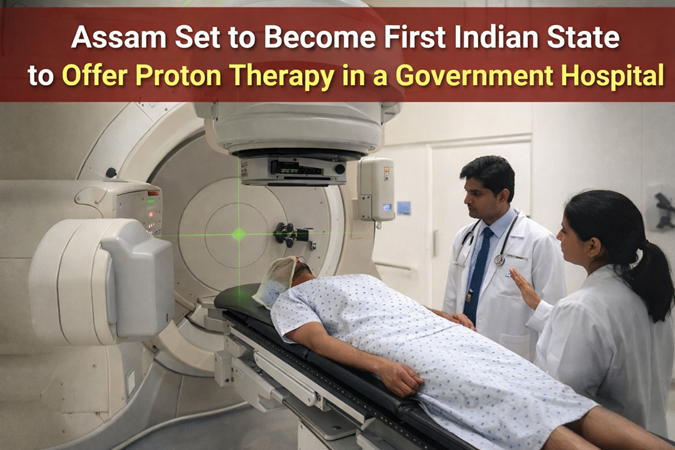
Proton therapy is an advanced type of radiation therapy that uses positively charged particles, known as protons, to treat cancer. Unlike conventional radiation therapy that uses X-rays, proton beams can be controlled with high precision, allowing doctors to target tumors more accurately while minimizing damage to surrounding healthy tissues.
According to oncology experts, this form of treatment is particularly beneficial for pediatric cancers, brain tumors, spinal cord tumors, and cancers located near critical organs. The reduced radiation exposure to healthy tissues often results in fewer side effects and improved quality of life for patients undergoing treatment.
Government Initiative and Planning
Officials from the Assam state health department confirmed that the project aims to integrate proton therapy into the public healthcare system, making it one of the most ambitious oncology infrastructure initiatives undertaken by any Indian state government.
“This initiative is aimed at ensuring equitable access to world-class cancer treatment facilities,” a senior health official stated. “By introducing proton therapy in a government hospital, Assam is setting a precedent for other states to follow.”
The project is expected to involve collaboration with national and international medical technology providers, given the complexity and cost of proton therapy systems. These systems require specialized infrastructure, including large accelerators and radiation shielding, making them among the most advanced medical installations globally.
Cost and Accessibility
Currently, proton therapy treatment in private hospitals in India can cost anywhere between ₹20 lakh to ₹30 lakh per patient, depending on the type and stage of cancer. This high cost has limited access primarily to affluent patients or those covered by comprehensive insurance plans.
By introducing this technology in a government hospital, Assam aims to significantly reduce treatment costs through public funding and subsidies. Officials have indicated that the treatment could be made available either free of cost or at highly subsidized rates under various government health schemes.
The move is expected to benefit not only patients from Assam but also those from neighboring northeastern states, where access to advanced cancer care facilities has historically been limited.
Healthcare Impact in Northeast India
The northeastern region of India has faced persistent challenges in healthcare infrastructure, particularly in specialized fields such as oncology. Patients often travel long distances to metropolitan cities like Delhi, Mumbai, or Chennai to access advanced treatments.
The establishment of a proton therapy center in Assam is expected to reduce this dependency significantly. It will also help in early diagnosis and timely treatment, which are critical factors in improving cancer survival rates.
According to available health data, India reports over 1.4 million new cancer cases annually. Experts believe that expanding access to advanced therapies like proton therapy can play a crucial role in improving treatment outcomes.
Technical and Infrastructure Requirements
Setting up a proton therapy facility involves substantial investment, often exceeding ₹1,000 crore. The technology requires a particle accelerator known as a cyclotron or synchrotron, along with specialized treatment rooms and highly trained medical personnel.
Sources indicate that Assam’s project will include multiple treatment gantries, advanced imaging systems, and integrated oncology care units. Training programs for doctors, physicists, and technicians are also expected to be part of the implementation plan.
Expert Opinions
Medical professionals have welcomed the move, noting its potential to transform cancer care accessibility in India.
“Proton therapy represents the future of radiation oncology,” said a senior oncologist associated with a national cancer institute. “Making it available in the public sector is a landmark decision that can significantly improve treatment equity.”
Public health experts have also emphasized the importance of such initiatives in bridging the urban-rural healthcare gap.
Future Outlook
The Assam government’s initiative is expected to encourage other states to explore similar investments in advanced healthcare technologies. If successfully implemented, it could pave the way for a broader transformation of India’s public healthcare system.
Officials have not yet announced a definitive timeline for the completion of the project, but initial reports suggest that phased development may begin within the next fiscal cycle.
As India continues to strengthen its healthcare infrastructure, the introduction of proton therapy in a government hospital represents a critical milestone in ensuring that advanced medical treatments are accessible to all sections of society.