Agreement Signed for Statewide Air Quality Push
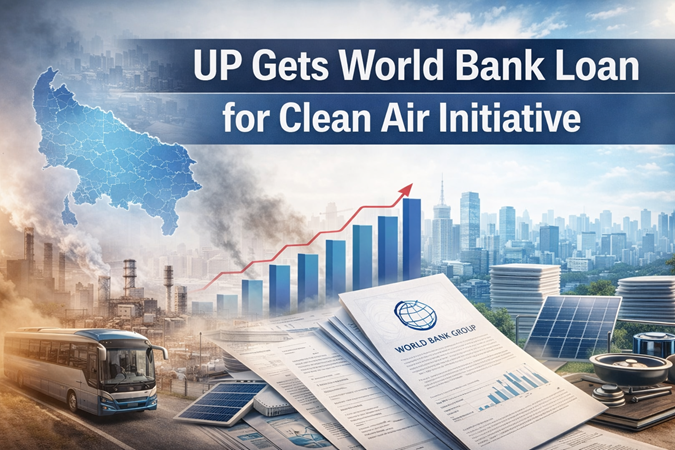
The agreement was signed in New Delhi on March 16, 2026. According to the World Bank, the program is designed to support Uttar Pradesh’s Clean Air Plan through integrated action in sectors that contribute significantly to particulate pollution. The project is not being framed as a narrow city-only intervention. Instead, it is built around a wider state-level and regional strategy, reflecting the view that air pollution in northern India often moves across district and state boundaries rather than staying confined to one urban center.
The official signatories included Juhi Mukherjee, Joint Secretary in the Department of Economic Affairs, Ministry of Finance, on behalf of the Government of India; B. Chandrakala, CEO of the Clean Air Management Authority and Secretary of Forest, Environment and Climate Change, on behalf of the Government of Uttar Pradesh; and Paul Procee, Acting Country Director for India, on behalf of the World Bank. The signing followed the World Bank Board’s earlier approval of financing for clean air programs in both Uttar Pradesh and Haryana in December 2025.
The Uttar Pradesh program is part of the World Bank’s wider Regional Air Quality Management Program in the Indo-Gangetic Plains and Himalayan Foothills, an area repeatedly identified as one of the world’s major air pollution hotspots. For Uttar Pradesh, the financing gives institutional backing to a longer transition already being discussed within the state’s clean air planning framework: moving away from scattered anti-pollution steps and toward a coordinated, evidence-based system that links policy, implementation, monitoring and financing.
Why This Program Matters for Uttar Pradesh
Uttar Pradesh sits at the center of the Indo-Gangetic air shed, where emissions from transport, industry, household fuels, agriculture and open burning can interact across long distances. World Bank project material says Uttar Pradesh is among the first Indian states to actively move toward an airshed management approach. That matters because state and city plans have often worked in silos, while the air pollution problem itself does not follow municipal boundaries.
The World Bank document says the program aims to strengthen systems for airshed management and support selected priority measures under the state’s clean air plan. It identifies some of the major pollution sources in Uttar Pradesh as residential cooking, agriculture, transportation and medium and small industries. That is why the program does not focus on just one measure, such as vehicle regulation or monitoring stations. It spreads intervention across the sectors that produce a large share of pollution exposure in both urban and rural settings.
This broader framing also ties the UP initiative to India’s national clean air architecture. The World Bank notes that the National Clean Air Programme, launched in 2019, initially focused on 132 non-attainment cities and later expanded toward broader state-level thinking. Its target, compared with a 2017 baseline, was first to reduce PM10 and PM2.5 concentrations by 20 to 30 percent and was then revised upward to 40 percent by 2026. In Uttar Pradesh, the state clean air plan has been designed to work alongside city-specific action plans rather than replace them.
What the USD 300 Million Loan Will Support
The most visible part of the program is likely to be the physical and service-level interventions planned under it. The World Bank says almost 200 new air quality monitors will be installed, with data received from the Uttar Pradesh Pollution Control Board. This matters because stronger monitoring networks are often the foundation for better regulation, targeted enforcement and more accurate public information.
Transport is another major pillar. The World Bank’s December 2025 approval note says the program will encourage cleaner mobility by supporting the introduction of 15,000 electric three-wheelers and 500 electric buses in Lucknow, Kanpur, Varanasi and Gorakhpur. It will also back the Uttar Pradesh government’s plans to provide incentives for replacing 13,500 polluting heavy-duty vehicles with lower-emission alternatives. The transport measures are designed not only to reduce pollution but also to improve urban connectivity and job access.
Household energy is also central to the initiative. The World Bank says the program will help 3.9 million households gain access to clean cooking. Supporting documents break this down into multiple pathways, including improved biomass cookstoves, household biogas systems and hybrid solar-electric induction solutions. This is significant because the project documents identify household cooking with solid fuels as one of the biggest contributors to PM2.5 exposure in the state, particularly in rural areas.
Industry and brick manufacturing are another focus area. The World Bank says more than 700 brick kilns will transition to resource-efficient technology. Its broader project documents also discuss cleaner technologies for micro, small and medium enterprises, including better pollution control, more efficient boilers and wider shifts away from dirtier fuels. In the case of brick kilns, the papers note that cleaner technologies such as zig-zag kilns can lower coal use and reduce black carbon and particulate emissions substantially.
Agriculture is included as well. The World Bank says farmers will be encouraged to adopt more efficient fertilizer use to improve productivity, and the program also links to better management of agricultural residue and livestock waste. This is important because air pollution in northern India is shaped not only by city traffic and industrial emissions, but also by rural emission sources and the chemistry of secondary particulate formation.
Jobs, Private Capital and Economic Framing
The clean air initiative is being presented not only as an environmental intervention but also as an economic transition program. Uttar Pradesh Chief Minister Yogi Adityanath said the state’s development path sees economic growth, productivity and ecological balance moving together. The World Bank also said the program is expected to create jobs, especially for youth and women, and to improve productivity in firms and sectors that adopt cleaner systems.
According to Paul Procee of the World Bank, the program is expected to leverage almost USD 150 million in private capital in the transport and MSME sectors. That suggests the public financing is intended to crowd in additional investment, rather than function only as a direct public spending line. The structure of the program therefore goes beyond classic environmental compliance. It ties air quality goals to electric mobility, industrial modernization and stronger state capability.
This framing is important for a state like Uttar Pradesh, which has repeatedly emphasized its ambition to scale up industrial output, logistics capacity, urban growth and employment. In official remarks tied to the agreement, the clean air program is positioned as part of a broader development strategy rather than a stand-alone environmental cost. That is one reason the project places heavy stress on institutional systems, implementation capacity and measurable results.
How the Program Is Structured
World Bank program material says the Uttar Pradesh Clean Air Management Program is designed around three broad result areas. The first is strengthening state capabilities for air quality management, including better data systems, monitoring capacity, analysis and coordination. The second is advancing priority sector interventions in areas such as clean cooking, agriculture, transport and MSMEs. The third is Indo-Gangetic Plains airshed cooperation, reflecting the reality that cross-border emissions matter greatly in northern India.
The documents also show that the program is intended to support the state’s longer-term clean air agenda through 2030. In project wording, the broader objective is to improve air quality across Uttar Pradesh by prioritizing the most cost-effective interventions. The World Bank says the state’s clean air plan screened a very large menu of control measures and narrowed them down based on feasibility, cost-effectiveness and expected pollution reduction.
One of the more notable points in the documents is that city-based sources account for only a part of the pollution problem, with a substantial share also coming from outside city limits and even outside the state. That is why the project repeatedly uses the term airshed. The idea is that air quality can only be managed effectively when governments track how emissions move and interact across wider geographies.
Loan Terms and Program Duration
The World Bank says the Uttar Pradesh clean air financing has a final maturity of 10 years, including a grace period of two years. The initiative is also receiving support from the multi-donor Energy Sector Management Assistance Program. These terms matter because clean air programs often require investments whose returns appear over time, especially when they involve technology adoption, institutional strengthening, infrastructure deployment and behavior change.
The signing announcement came after the World Bank Board approved financing in December 2025 for two clean air programs, one in Uttar Pradesh and one in Haryana. In that approval note, the Bank said the two programs together were intended to help improve air quality for roughly 270 million people. That wider context matters because Uttar Pradesh’s program is not being treated in isolation. It is part of a regional policy and financing shift focused on the Indo-Gangetic pollution corridor.
What to Watch Next
The key question now is implementation. The financing agreement establishes the program framework, but the success of the initiative will depend on rollout across transport agencies, pollution control systems, district institutions, urban bodies, agriculture departments and industrial stakeholders. The World Bank’s own documents stress the need for stronger monitoring, clearer coordination, trained staff and better integration between environment departments and sector departments.
For Uttar Pradesh, the clean air financing package creates a new benchmark in scale and design. It combines state-level planning, targeted investments, institutional reform and regional airshed thinking in a way that few earlier air quality programs in India have attempted at the state level. The headline number is the USD 300 million World Bank loan, but the larger story is the architecture behind it: a long-duration program tying air quality, public health, urban transport, rural energy, industrial transition and development policy into a single framework.