Sahitya Akademi Awards 2025 announced across 24 Indian languages
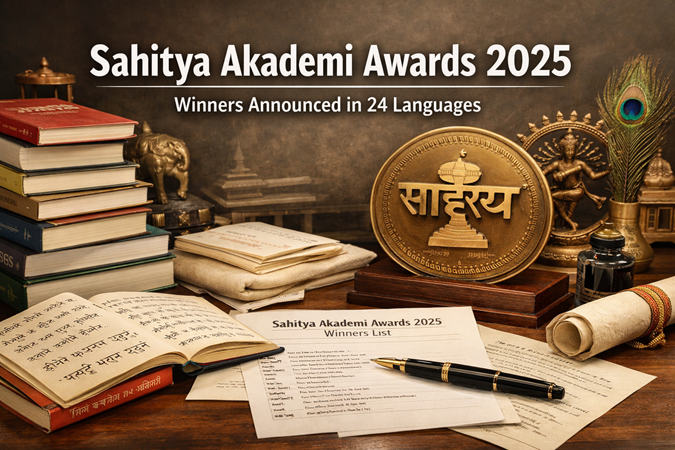
The official announcement confirms that the annual awards have been declared in all the 24 languages recognised by Sahitya Akademi. These awards are among the country’s best-known literary honours, and the Akademi itself describes the prize as an annual recognition for the most outstanding books of literary merit published in the major Indian languages recognised by it. The institution says it has been giving the award since its inception in 1954, with the first awards presented in 1955. The Akademi also identifies itself as India’s National Academy of Letters and says it is the only institution in the country that undertakes literary activities in 24 Indian languages, including English.
That wider institutional background matters because the Sahitya Akademi Awards are not limited to a single literary tradition or language bloc. The Akademi’s recognised-language structure covers the 22 languages listed in the Constitution, along with English and Rajasthani. This framework is what gives the annual awards their national character. They do not merely spotlight one literary market or one dominant publishing language. Instead, they bring together writing from many linguistic traditions, often putting regional literary production into a national conversation.
The 2025 list does exactly that. It stretches from Assamese, Bengali and Bodo to Tamil, Telugu and Urdu, and from English and Hindi to Santali, Sindhi and Rajasthani. The result is a winners list that is national in scope but deeply rooted in language-specific literary cultures.
What the official announcement says
According to the PIB release issued on behalf of the Ministry of Culture, the awards were announced on 16 March 2026. The same release states that the award process for the 2025 cycle began in January 2025 with an open advertisement. The books selected this year came through a process involving jury recommendations in all 24 languages, after which the final list was approved by the competent authority of Sahitya Akademi.
The official category-wise distribution is one of the most useful details in the release because it shows where the literary balance lies this year. Poetry leads with 8 awards, making it the single largest category in the 2025 cycle. Novels account for 4 awards, short story collections for 6, essays for 2, while one title each was chosen in literary criticism and autobiography. Two titles won in the memoir category. That spread shows that the awards are not limited to fiction alone; nonfiction and reflective writing remain strongly represented as well.
The official release also sets out the award package. Each winner is to receive an engraved copper plaque, a shawl, and prize money of ₹1,00,000. The presentation ceremony is scheduled to take place on 31 March 2026 in New Delhi. These are the formal details that define the 2025 edition as an announced award cycle moving quickly from declaration to ceremony within the same month.
A selection process that changed in 2025
One of the most significant procedural details linked to this year’s awards is that Sahitya Akademi introduced a changed selection route for the 2025 cycle. In a separate PIB note dated 30 January 2025, the Akademi said that for the first time it had invited books directly from authors, publishers and their well-wishers for consideration in the main award process across 24 recognised languages. That same note said the books eligible for the 2025 award year were those published between 1 January 2019 and 31 December 2023, with the last date for submission fixed as 28 February 2025.
This is an important detail for readers who follow literary institutions closely, because it means the 2025 cycle was not only about the final winners. It also marked a procedural shift in how books entered the selection pipeline. The direct-invitation model expanded the submission route beyond earlier, narrower channels and publicly advertised the process in newspapers across all 24 recognised languages. In a literary landscape where visibility can vary sharply by language and region, that procedural step is likely to be remembered as one of the defining features of the 2025 awards cycle.
Which genres dominated this year
The category distribution offers a clear snapshot of the 2025 awards landscape. Poetry took the largest share, with books in Bengali, Dogri, Gujarati, Kashmiri, Odia, Sanskrit, Telugu and Urdu among the winners. That immediately makes poetry the strongest recurring form in this year’s list. The novel category included winners in Assamese, Bodo, English and Malayalam, while short story collections were selected in Kannada, Manipuri, Punjabi, Rajasthani, Santali and Sindhi.
The nonfiction wing of the list is equally notable. Konkani and Nepali each saw winning essay titles. Tamil was represented through a work of literary criticism. Marathi received the award for autobiography, while Hindi and Maithili featured in memoir. Taken together, the distribution shows that the Akademi has spread its recognition across both creative and reflective literary forms rather than concentrating only on novels or poetry.
For readers and publishers, that matters because it broadens the annual public conversation around literature. A memoir winner and an essay winner do not attract the same reading communities as a poetry collection or a novel. By distributing awards across forms, the Sahitya Akademi Awards also distribute attention across different parts of the literary ecosystem.
Notable winners from the 2025 list
The 2025 winners list includes several names that are likely to draw wider national attention. In English, the award has gone to Navtej Sarna for the novel Crimson Spring. In Hindi, the memoir Jeete Jee Allahabad by Mamta Kalia has won. In Odia, the poetry title Padapurana by Girijakumar Baliyar Singh has been selected, while in Telugu, the poetry collection Animesha by Nandini Sidha Reddy has won.
The Tamil award goes to Sa. Tamilselvan for Thamiz Sirukathaiyin Thadangal, a work of literary criticism. In Rajasthani, Jitender Kumar Soni has won for the short story collection Bharkhama. In Punjabi, the short story book Safety Kit by Jinder has been selected. In Malayalam, the winning novel is Maayaamanushyar by N. Prabhakaran.
Other winners on the official list include Devabrat Das for Assamese, Prasun Bandyopadhyay for Bengali, Sahaisuli Brahma for Bodo, Khajur Singh Thakur for Dogri, Yogesh Vaidya for Gujarati, Amaresh Nugadoni for Kannada, Ali Shaida for Kashmiri, Henry Mendonca (H.M. Pernal) for Konkani, Mahendra for Maithili, Haobam Nalini for Manipuri, Raju Baviskar for Marathi, Prakash Bhattarai for Nepali, Mahamahopadhyaya Sadhu Bhadreshdas for Sanskrit, Sumitra Soren for Santali, Bhagwan Atlani for Sindhi and Pritpal Singh Betab for Urdu.
Full winners list of Sahitya Akademi Awards 2025
| Language | Winning Book | Genre | Author |
|---|---|---|---|
| Assamese | Karhi Khelar Sadhu | Novel | Devabrat Das |
| Bengali | Shrestha Kabita | Poetry | Prasun Bandyopadhyay |
| Bodo | Dwngnwi Lama Mwnse Gathwn | Novel | Sahaisuli Brahma |
| Dogri | Thakur Satsayie | Poetry / Couplets | Khajur Singh Thakur |
| English | Crimson Spring | Novel | Navtej Sarna |
| Gujarati | Bhattkhadaki | Poetry | Yogesh Vaidya |
| Hindi | Jeete Jee Allahabad | Memoir | Mamta Kalia |
| Kannada | Dada Seerisu Tande | Short Stories | Amaresh Nugadoni |
| Kashmiri | Najdavanek’y Pot Aalav | Poetry | Ali Shaida |
| Konkani | Konkani Kavyem: Rupani Ani Rupakam | Essays | Henry Mendonca (H.M. Pernal) |
| Maithili | Dhatri Paat San Gaam | Memoir | Mahendra |
| Malayalam | Maayaamanushyar | Novel | N. Prabhakaran |
| Manipuri | Kanglamdriba Eephut | Short Stories | Haobam Nalini |
| Marathi | Kalyanilya Resha | Autobiography | Raju Baviskar |
| Nepali | Nepali Paramparik Sanskriti Ra Sabhyata Ko Dukuti | Essays | Prakash Bhattarai |
| Odia | Padapurana | Poetry | Girijakumar Baliyar Singh |
| Punjabi | Safety Kit | Stories | Jinder |
| Rajasthani | Bharkhama | Stories | Jitender Kumar Soni |
| Sanskrit | Prasthanacatustaye Brahmaghosah | Poetry | Mahamahopadhyaya Sadhu Bhadreshdas |
| Santali | Mid Birna Chenne Saon Inag Sagai | Short Stories | Sumitra Soren |
| Sindhi | Waghoo | Stories | Bhagwan Atlani |
| Tamil | Thamiz Sirukathaiyin Thadangal | Literary Criticism | Sa. Tamilselvan |
| Telugu | Animesha | Poetry | Nandini Sidha Reddy |
| Urdu | Safar Jaari Hai | Poetry | Pritpal Singh Betab |
Why the Sahitya Akademi Awards matter in Indian literature
The annual Sahitya Akademi Awards matter because they sit at the intersection of language, publishing and national recognition. Unlike awards that operate mainly in one language or in one segment of the market, these prizes work across the multilingual framework recognised by the Akademi. The institution says it is the central body for literary dialogue, publication and promotion in the country, and that role gives its annual awards a wider public meaning. For many writers, this recognition brings a work from a regional-language readership into the national literary conversation.
The awards also matter because they acknowledge literary merit across genres that are not always equally visible in mainstream media coverage. A poetry collection in Kashmiri, an essay volume in Nepali, a memoir in Maithili or a work of literary criticism in Tamil may not all receive the same level of attention in a commercial publishing market. Yet under the Akademi’s award structure, each language and form enters the same national frame. That remains one of the most important institutional features of the Sahitya Akademi system.
There is also a historical dimension to that role. The Akademi was formally inaugurated in 1954 and says the first awards were presented in 1955. Over the decades, the award amount itself changed several times, eventually reaching the current ₹1,00,000 level from 2009 onward. Even as the monetary value evolved, the core identity of the award remained the same: recognition for an outstanding book of literary merit in a recognised language.
What readers should watch after the announcement?
Now that the announcement has been made, the next immediate milestone is the 31 March 2026 presentation ceremony in New Delhi. Beyond that, the awards are likely to trigger renewed discussion around translations, reprints, literary festivals and cross-language readership. Sahitya Akademi’s own structure is built around literary exchange, seminars, publications and translation activity, and award-winning titles often receive fresh attention after the official announcement.
For readers, the 2025 list offers more than a set of names. It provides a map of current literary recognition across Indian languages. For publishers, it offers a benchmark for what kinds of books were judged most significant in this cycle. And for anyone tracking Indian literature as a national field rather than a set of isolated language markets, the Sahitya Akademi Awards 2025 remain one of the year’s most important official literary announcements.