
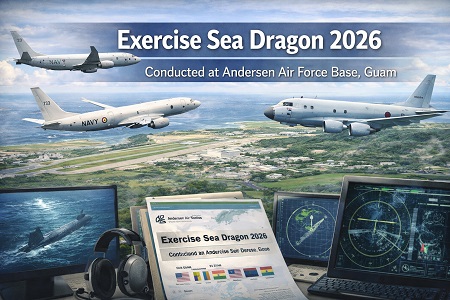
Sea Dragon 2026 begins in Guam with five-nation participation
The official U.S. Pacific Fleet release says Sea Dragon 2026 started at Andersen Air Force Base on March 9 with a large multinational lineup of maritime patrol aircraft. The exercise opened with two U.S. Navy P-8A Poseidon aircraft, one each from Patrol Squadron 4 and Patrol Squadron 45. They were joined by one Indian Navy P-8I, one Japan Maritime Self-Defense Force P-1, two Royal Australian Air Force P-8A aircraft and one Royal New Zealand Air Force P-8A. In total, that means the exercise opened with seven aircraft operating under a common anti-submarine warfare framework.
The participating countries are the United States, India, Japan, Australia and New Zealand. While Sea Dragon is led by the U.S. Navy, its structure is clearly multinational. The aircraft mix itself reflects that. The United States and its partner forces are not simply observing one another. They are flying, planning and being evaluated in the same training environment.
The Japanese Maritime Staff Office said the purpose of its participation is to improve tactical capabilities and strengthen cooperation among participating countries in support of a Free and Open Indo-Pacific. That wording captures the larger framework in which the exercise is being presented by partner governments: high-end military training, but also long-term regional coordination among like-minded maritime forces.
What Sea Dragon 2026 is designed to do
Sea Dragon is a specialist anti-submarine warfare exercise, not a broad naval drill covering every mission set. According to the U.S. Pacific Fleet, Sea Dragon 2026 advances aircrew proficiency by moving from track-simulated targets to the more demanding phase of detecting and tracking a live submarine. That progression is important because it gives the exercise a layered training structure. Crews begin with controlled scenarios and then move into more complex real-world submarine-hunting conditions.
The same U.S. release says crews will complete more than 200 cumulative hours of in-flight training. In addition to flying missions, aircrews and pilots from all participating countries take part in classroom training sessions, where they build mission plans and discuss tactics that incorporate the capabilities and equipment of their respective services. That means the drill is not only about flying time. It is also about how different forces compare procedures, exchange operational thinking and align methods before missions are flown.
The Australian Defence release adds that participants are tested on speed, accuracy and coordinated mission execution. That gives a practical idea of what success in the drill looks like. It is not just about detecting a submarine. It is about how quickly, precisely and collectively crews can identify, track and respond in a complex operating environment.
Why Andersen Air Force Base and Guam matter
The location is a major part of the story. Guam sits at an important point in the western Pacific, and Andersen Air Force Base has long served as a key hub for aviation operations in the broader Indo-Pacific theatre. Official partner statements repeatedly identify the training area near Guam as one of the reasons the exercise is valuable.
Australian Defence said the exercise benefits from an expansive overwater training area near Guam, allowing aircrews to work through complex scenarios in a maritime environment suited to anti-submarine warfare training. This matters because ASW is highly dependent on geography, sensor coordination, communication discipline and endurance over water. A large operating area allows crews to practise long-range tracking and coordination under realistic conditions.
The Japanese release also formally identifies the exercise area as being in the vicinity of Guam. The New Zealand Defence Force, meanwhile, notes that Sea Dragon is held annually at the United States’ Andersen Air Force Base. Together, these official descriptions underline that Guam is not merely a convenient host location. It is part of the exercise’s operational value.
India’s role in Sea Dragon 2026
India is participating with a P-8I maritime patrol aircraft, the Indian Navy’s long-range maritime reconnaissance and anti-submarine warfare platform. On its official platform page, the Indian Navy describes the P-8I as a multi-role Long Range Maritime Reconnaissance Anti-Submarine Warfare aircraft that can be equipped with missiles and torpedoes, and used for surveillance, strike, search and rescue and submarine detection roles.
That matters because Sea Dragon is exactly the kind of environment in which the P-8I’s mission profile becomes relevant. The aircraft is designed for long-range maritime surveillance and ASW operations, so its participation in a U.S.-led multinational submarine-hunting drill fits squarely with its operational role. The exercise also places the Indian Navy alongside other operators of closely related long-range maritime patrol aircraft, particularly the P-8 family flown by the United States, Australia and New Zealand.
For India, the exercise offers practical exposure to shared tactics, common operating concepts and multinational coordination in anti-submarine warfare. It also places the Indian Navy in a format where performance is not only observational but competitive and assessed.
Australia, New Zealand and Japan bring their own focus
Australia’s official release says the Royal Australian Air Force deployed a P-8A Poseidon aircraft and 50 aviators to Guam for Sea Dragon 2026. It also said aviators from the recently re-formed No. 12 Squadron would test their skills across the two-week exercise while working to detect and track both simulated and live submarine targets. Squadron Leader Bryce Martin described the exercise as an opportunity to sharpen skills and strengthen international partnerships.
New Zealand’s Defence Force said its RNZAF P-8A Poseidon flew from RNZAF Base Ohakea to Guam to join the exercise. It described Sea Dragon as a chance for crews to develop anti-submarine warfare skills while refining how they work with partner nations in a range of situations. Air Commodore Andy Scott said the exercise helps ensure New Zealand can work seamlessly with partner nations when required for regional security.
Japan’s Maritime Staff Office said the Japan Maritime Self-Defense Force is participating with Air Patrol Squadron Three flying the P-1, with approximately 40 personnel. Japan’s official release identifies the exercise objectives as improving tactical capability and strengthening cooperation among participating countries. That framing is consistent with the other partner releases, which all emphasize both national proficiency and coalition interoperability.
The competitive side: the Dragon Belt
Sea Dragon is not only a training event. It also includes a competitive format. The U.S. Pacific Fleet says each event in the exercise will be assessed and graded, with the nation achieving the highest total points receiving the Dragon Belt. That makes the drill more than a coordination exercise. It also becomes a performance benchmark among participating crews.
The official U.S. release also provides recent Dragon Belt history. It says the Japan Maritime Self-Defense Force earned the highest total score in 2022 and then successfully defended the title in 2023 and 2024. In 2025, the belt was claimed by RAAF No. 11 Squadron, which returned this year to defend the title. New Zealand’s official release likewise notes that Australia is the current holder from the 2025 exercise.
This competitive structure matters because it pushes crews beyond routine participation. Nations are being measured on outcomes, and that tends to sharpen planning, mission discipline and execution quality. It also gives the exercise a visible result that can be tracked across years, adding a continuity element to what is already an annual ASW event.
An annual exercise with a growing profile
The U.S. Pacific Fleet says Exercise Sea Dragon has been held annually since 2019. That makes Sea Dragon 2026 part of an established sequence rather than a first-time initiative. Over time, recurring exercises like this build familiarity not only with procedures and tactics, but also with the operational habits of partner forces.
The continuity is important in anti-submarine warfare, which is one of the most demanding and coordination-heavy areas of maritime operations. Submarine detection and tracking depend on planning discipline, sensor integration, communication standards, crew judgment and endurance. Those skills are strengthened by repetition, and multinational repetition adds another layer because each country brings its own systems, methods and operational culture.
The U.S. release also notes that the participating classroom sessions include discussion of the capabilities and equipment of the various countries. That detail helps explain why recurring annual drills matter. They allow personnel to learn how partner assets are used in practice, not just in theory.
Why Sea Dragon 2026 is drawing attention
The immediate reason Sea Dragon 2026 is in the news is straightforward: it is a live, ongoing multinational anti-submarine warfare exercise involving five Indo-Pacific partners and being staged from a strategically significant base in Guam. But the official releases also make clear why it has a larger profile. The exercise combines advanced ASW flying, tactical planning, competition, interoperability and repeated multinational participation in one format.
For the United States, India, Japan, Australia and New Zealand, that means the exercise serves several purposes at the same time. It improves aircrew proficiency. It builds familiarity among partner forces. It tests tactics against simulated and live submarine scenarios. It also creates a repeatable framework for cooperation in maritime patrol and undersea surveillance roles.
None of the official partner statements frame the exercise as symbolic. They describe it in operational terms: aircraft deployments, personnel commitments, evaluated events, specific ASW tasks and live-submarine tracking. That is why the exercise matters. It is built around mission execution rather than ceremony.
What happens during the rest of the exercise
With the exercise period running through late March, the remaining phase of Sea Dragon 2026 is expected to continue the same pattern already laid out in the official releases: classroom coordination, airborne missions, target tracking, live-submarine detection work and event-based evaluation. The Japanese release gives the overall exercise period as March 9 to March 24, which provides the clearest published time window among the official documents currently available.
The headline remains that Sea Dragon 2026 is being conducted at Andersen Air Force Base in Guam. But the fuller story is about how that headline translates into real activity: seven aircraft from five partner nations, more than 200 hours of in-flight training, a competitive scoring format, and a shared focus on anti-submarine warfare in the Indo-Pacific.