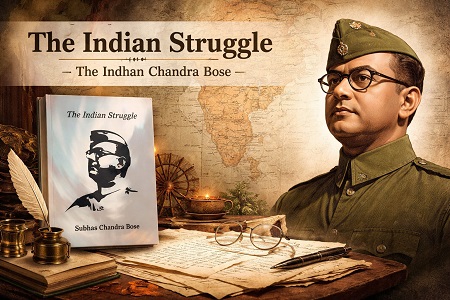
The Indian Struggle 1920–1942 is one of the most important political books associated with India’s freedom movement because it is not just a historical narrative but also a firsthand interpretation by one of the movement’s central figures, Subhas Chandra Bose. The book is a two-part work covering the turbulent decades between 1920 and 1942, from the rise of mass anti-colonial politics to the more militant and international phase of the struggle. The first part was published in London in 1935, while the later portion was written in Europe during the Second World War; the work was banned in colonial India and became available there only after independence.
What makes the book especially significant is the position from which it was written. Bose was not a distant observer trying to reconstruct events from archives decades later. He was a direct participant in the political developments he described. Modern editions and publisher descriptions present the book as Bose’s major political study of the freedom movement, while the text itself openly states that it was written by someone who had played “an intimate part” in the struggle he narrated. That gives the book a distinctive tone: it reads as history, political analysis, ideological reflection, and personal testimony at the same time.
The historical range of the book is one of its greatest strengths. It follows the Indian national movement from the Non-Cooperation and Khilafat movements of the early 1920s to the Quit India and Azad Hind phase of the early 1940s. In doing so, it captures a period when Indian politics changed from elite-led constitutional agitation into a broad-based mass movement involving students, workers, peasants, political prisoners, social reformers, and revolutionaries. The title itself signals that Bose saw these years not as disconnected episodes but as parts of one long, escalating national struggle.
A major theme running through the book is Bose’s attempt to explain how Indian nationalism evolved in strategy, leadership, and social character. He pays close attention to the role of the Indian National Congress, but he does not treat Congress as a static institution. Instead, he presents it as a body shaped by internal debates, changing leadership styles, and competing visions of how freedom should be won. This is one reason the book remains valuable even today: it helps readers understand that the freedom movement was not ideologically uniform. It was a field of argument as much as a united cause. Publisher descriptions of the book specifically note Bose’s reflection on key themes in Indian history and his sharply drawn assessment of Gandhi’s role.
Bose’s treatment of Mahatma Gandhi is one of the most discussed aspects of the work. He clearly recognizes Gandhi’s enormous role in turning nationalism into a mass force, but he is also critical of what he saw as restraint, compromise, and tactical withdrawal at key moments. Bose belonged to a more militant current within the freedom struggle, and reference works on his life consistently note that his politics differed from Gandhi’s less confrontational approach. That difference appears throughout The Indian Struggle. The book therefore becomes important not only as a record of events, but also as a document of ideological divergence inside the anti-colonial movement itself.
Another powerful feature of the book is its insistence that India’s independence movement cannot be understood only through speeches, resolutions, or negotiations with the British. Bose places equal weight on the emotional energy of mass politics, the impatience of youth, the rise of radical nationalism, and the growing belief that mere constitutional reform would never be enough. His broader political outlook, as described by Britannica and other summaries, was more militant and more oriented toward strong mobilization, industrial development, and disciplined organization than the Gandhian line. That helps explain why the book often feels urgent rather than detached. Bose is not merely telling the reader what happened; he is constantly asking what kind of political will was required to defeat empire.
The book is also notable for the way it connects Indian politics to the wider world. Bose wrote part of it while in Europe, and the work reflects an awareness that the Indian struggle was unfolding in a global age shaped by imperialism, ideological conflict, war, and international realignment. Even when the focus remains squarely on India, the narrative suggests that the freedom movement was never purely domestic in meaning. It was part of a larger twentieth-century crisis of empire. This international angle adds depth to the book and helps explain why it drew attention outside India as well. Publisher notes say the work was warmly received in European literary and political circles even as colonial authorities banned it in India.
From a literary and intellectual point of view, The Indian Struggle is compelling because it combines clarity with conviction. Bose writes with the authority of someone who believes history is still unfolding. He is analytical, but he is never cold. He is partisan, but not careless. That combination gives the work its force. Readers do not come away with a neutral textbook impression; they come away with the feeling that the Indian freedom movement was full of pressure, sacrifice, conflict, and unresolved possibility. The continuing popularity of modern editions from major publishers and research institutions suggests that the book still speaks to readers interested in political history, nationalism, leadership, and anti-colonial thought.
The book’s publication history is itself part of its importance. The first part was published in London in 1935, and colonial authorities banned it from circulation in India. Sources tied to later editions note that it could only be published in India in 1948, after independence. That fact alone shows how seriously the colonial state took Bose’s interpretation of the struggle. A book is banned not because it is irrelevant, but because it is seen as politically dangerous. In this case, the ban underlines the power of the text as an anti-imperial intervention, not simply as a literary work.
For present-day readers, The Indian Struggle 1920–1942 remains important for at least three reasons. First, it gives a participant’s view of India’s freedom movement from within its fiercest internal debates. Second, it provides a counterpoint to more familiar narratives centered almost entirely on Gandhian politics. Third, it reminds readers that the movement for independence included many strands: constitutionalists, mass agitators, socialists, revolutionaries, internationalists, and armed resisters. Bose’s book does not erase those differences; it brings them into the foreground. That makes it especially valuable for anyone trying to understand the freedom struggle in its full political complexity.
In the end, The Indian Struggle 1920–1942 stands as more than a historical account. It is a political statement, a participant’s testimony, and a major interpretive work on one of the defining movements of modern history. Its enduring value lies in the way it captures both the momentum and the tensions of the Indian national movement. Bose presents independence not as an inevitable gift of history, but as something forged through organization, sacrifice, argument, and determination. That is why the book continues to matter: it helps readers see the Indian freedom struggle not as a closed chapter, but as a living field of ideas, leadership, and national purpose.