As generative AI reshapes student writing, research, and assessment, universities across the United States are reviving oral exams, oral defenses, and live check-ins as a way to verify authentic learning.
That is why oral exams are back. Not because universities suddenly became nostalgic, but because written work alone is no longer always enough to establish authentic learning.
Quick Answer: Why Are U.S. Colleges Using Oral Exams Because of AI?
U.S. colleges are increasingly using oral exams because generative AI has made it easier for students to submit written work that may not fully reflect their own understanding. Oral exams help instructors verify whether students can explain, defend, and apply the material in real time. Colleges see oral assessment as one way to protect academic integrity, reduce dependence on unreliable AI detectors, and restore confidence that graded work reflects genuine learning.
Why This Issue Has Become So Urgent in U.S. Higher Education
The return of oral exams is happening in the middle of a much larger crisis in higher education. Generative AI tools have become fast, cheap, and widely available. Students can now use them to draft essays, rewrite paragraphs, summarize readings, generate code, and create polished academic language within minutes. For instructors, that changes the meaning of assessment itself.
Faculty concern is now widespread. National survey findings have shown that large majorities of college instructors believe students are using AI to write papers, paraphrase work, and complete assignments in ways that blur the line between assistance and substitution. Many also say they are worried that AI reduces critical thinking, originality, and deep engagement with course material.
This is the context in which oral exams are resurfacing. Colleges are not simply trying to catch misconduct. They are trying to rebuild confidence in the evidence of learning.
The Deeper Problem: Written Work Is No Longer the Same Kind of Evidence
For decades, written assignments served as one of the main ways colleges measured thinking. A paper, take-home exam, or written reflection was assumed to reveal understanding. Generative AI has weakened that assumption. A student can now submit work that looks polished, organized, and intellectually competent without having produced the reasoning in the same way educators once expected.
This is why the debate is larger than cheating. The real problem is evidentiary collapse. A finished product can look like mastery without actually proving mastery. Once that happens, universities need new ways to verify whether a student can truly explain what they submitted.
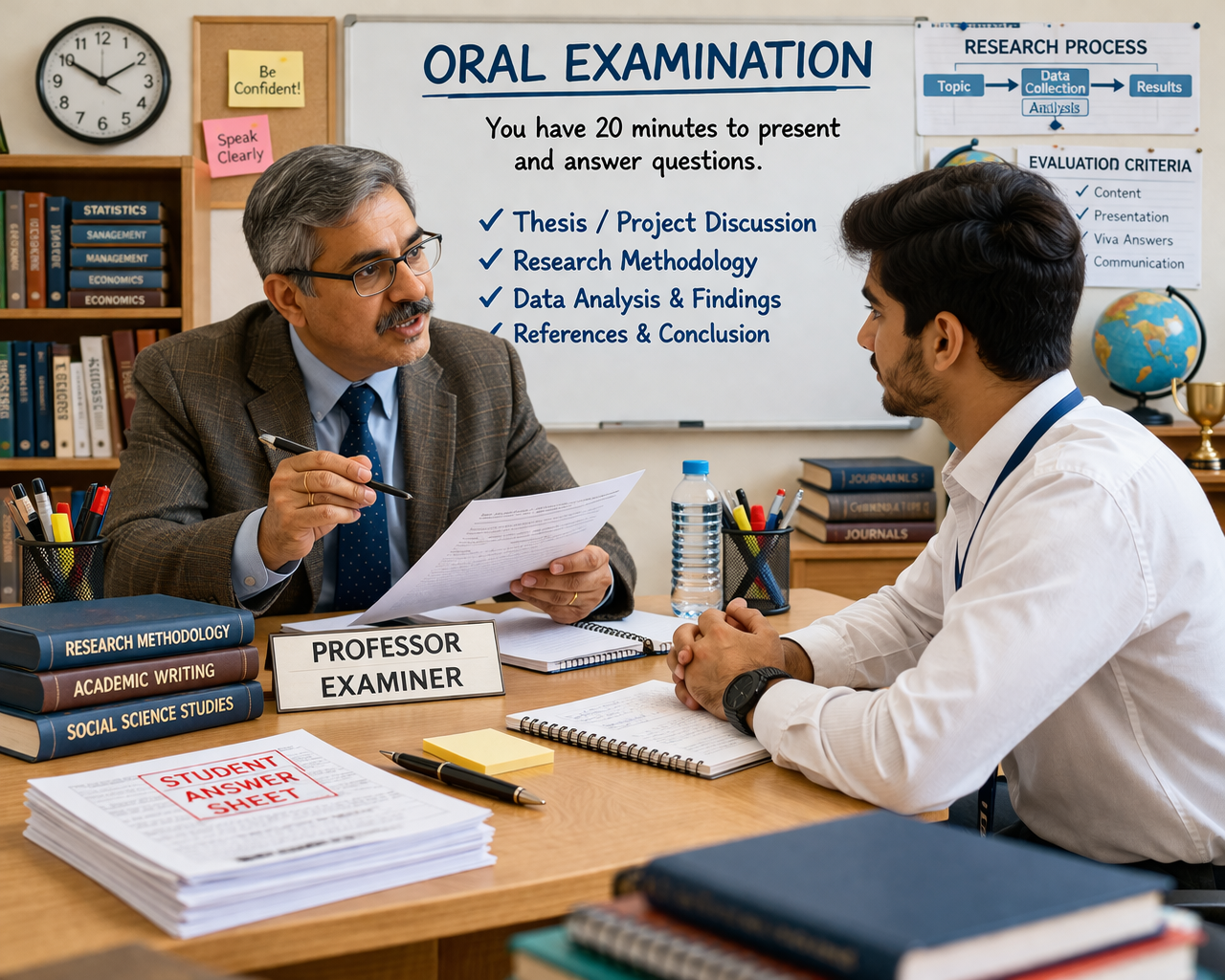
Oral exams answer that need by requiring students to think in real time. They must explain their reasoning, respond to follow-up questions, defend a method, and adapt when the examiner changes the scenario. That makes superficial outsourcing much harder and genuine understanding much more visible.
Why Oral Exams Feel Like a Strong Response to AI Cheating
Oral exams appeal to colleges because they do more than make cheating harder. They also reveal reasoning instead of just polished output. A generative AI system can produce fluent academic prose, but it cannot easily replace a student’s live ability to justify choices, clarify assumptions, and think through complications under questioning.
They also align with authentic assessment. In the professional world, people are often expected to explain their work aloud. Engineers defend design decisions. Doctors explain treatment plans. Lawyers justify interpretations. Researchers answer questions about methods and results. Oral exams mirror those real-world demands more closely than many traditional take-home assignments.
In other words, oral exams are attractive not just because they are harder to fake, but because they test the kind of thinking colleges increasingly want to see.
Case Study: Cornell University
One of the clearest examples comes from Cornell University. Recent reporting has highlighted how faculty members are using oral defenses after written submissions to verify whether students actually understand their own work. Instead of relying only on a submitted problem set, instructors can ask students to walk through the logic and defend key decisions in a short live exchange.
Cornell has also supported oral assessment at the institutional level through teaching programming and faculty development. That matters because it shows oral exams are moving beyond individual experimentation and becoming part of a larger response to AI-related assessment challenges.
Cornell’s examples also suggest that oral assessments can be structured in ways that scale farther than many people assume, especially when they are short, focused, and tied to specific learning outcomes.
Case Study: University of Pennsylvania
The University of Pennsylvania offers another important example. Penn has framed oral assessments as a way for students to show what they authentically know and how they think at a time when generative AI complicates traditional evaluation. This is a significant shift in language. The focus is not only on dishonesty, but on authentic demonstration of thought.
Penn’s faculty-development programming has also included oral check-ins and milestone conversations as tools for assessing student learning. That suggests oral assessment is becoming part of a wider pedagogical toolkit rather than a niche anti-cheating tactic.
Case Study: UC San Diego
UC San Diego provides some of the strongest evidence that oral exams may help learning as well as integrity. In engineering and computer science settings, university reporting on an NSF-funded project has indicated that students who participated in oral exams showed stronger later performance and higher motivation to learn.
These findings matter because they suggest oral exams do not merely function as a policing mechanism. They may also encourage deeper preparation and more durable conceptual understanding.
Case Study: NYU Stern and AI-Administered Oral Exams
NYU Stern provides one of the most forward-looking examples. There, faculty experimentation has explored using voice-based AI systems to administer oral exams at low cost and greater scale. The idea is striking: the same technological shift that destabilized traditional assessment may also help colleges rebuild it in new forms.
This does not eliminate the challenges. AI-administered oral exams create their own questions around fairness, design quality, and student experience. But they also point toward a hybrid future in which written work is paired with scalable verbal verification.
Why Colleges Are Not Simply Relying on AI Detectors
One major reason oral exams are gaining traction is that many institutions do not trust AI detectors enough to make them the foundation of academic integrity. Universities have increasingly warned that detector tools are unreliable, prone to false positives, and not strong enough to serve as definitive evidence of misconduct.
That shifts the focus away from post-submission policing and toward better assessment design. Oral exams fit that design-based approach because they verify understanding directly rather than trying to infer it from suspicious writing patterns.
The Strongest Arguments in Favor of Oral Exams
The appeal of oral exams lies in several advantages at once. They help verify authorship more directly than written submissions alone. They reveal reasoning rather than surface fluency. They reward depth of understanding. They align with real-world professional communication. They may improve student motivation and later performance. And they reduce dependence on AI-detection systems that many instructors do not fully trust.
They also create more direct human contact between student and instructor, which can surface nuance, uncertainty, and genuine understanding in ways that standardized written grading sometimes misses.
The Biggest Concerns and Criticisms
Oral exams are not a perfect solution. They can be labor-intensive, difficult to scale, and stressful for students. Without careful design, they may also introduce accessibility and fairness concerns related to anxiety, language background, accent, neurodivergence, disability, or cultural differences in communication style.
That means colleges need to be careful. Clear rubrics, examiner training, accommodations, transparent expectations, and thoughtful workload planning are all essential if oral exams are going to expand responsibly.
What the Future of College Assessment Probably Looks Like
The most likely future is not one in which all written work disappears and every class becomes a viva. A more realistic path is a hybrid model. Students may still write essays and complete projects, but major assignments are paired with brief oral defenses, milestone check-ins, or verbal reflections that confirm ownership and understanding.
This hybrid approach preserves the strengths of written work while restoring some of the authenticity checks that AI has weakened. It also aligns with what many leading institutions already appear to be exploring.
Conclusion
U.S. colleges are turning to oral exams because generative AI has changed the meaning of written assessment. When a machine can produce polished academic language on demand, universities need new ways to verify what a student actually knows. Oral exams offer one of the clearest answers because they make understanding visible in real time.
They are not effortless, universally fair, or suitable for every context. But they are gaining ground because they address a question that higher education can no longer ignore: if AI can write the answer, how do you know the student understands it? For many colleges right now, the answer is simple. Ask them to explain it out loud.
Frequently Asked Questions
Why are U.S. colleges turning to oral exams?
U.S. colleges are turning to oral exams because generative AI has made it easier for students to submit written work that may not fully reflect their own understanding. Oral exams help professors verify whether students can explain and defend the material in real time.
Do oral exams prevent AI cheating in college?
Oral exams do not eliminate AI cheating entirely, but they make it much harder for students to rely on AI-generated work without understanding it. They are especially useful for verifying authentic learning.
Which universities are using oral exams in response to AI?
Current reporting and university materials point to examples including Cornell University, the University of Pennsylvania, UC San Diego, and NYU Stern.
Are oral exams better than AI detectors?
Many educators consider oral exams more reliable than AI detectors because detectors can produce false positives and are not widely trusted as proof of misconduct.
What are the drawbacks of oral exams?
The main drawbacks are faculty workload, scaling challenges, student anxiety, accessibility concerns, and the risk of bias if the exam is not carefully structured.