India’s education transformation is no longer limited to enrollment, literacy, or access to classrooms. It is now moving decisively into a new era defined by digital infrastructure, public platforms, AI readiness, and future-focused school reform. The latest signal from the Government of India makes that unmistakably clear.
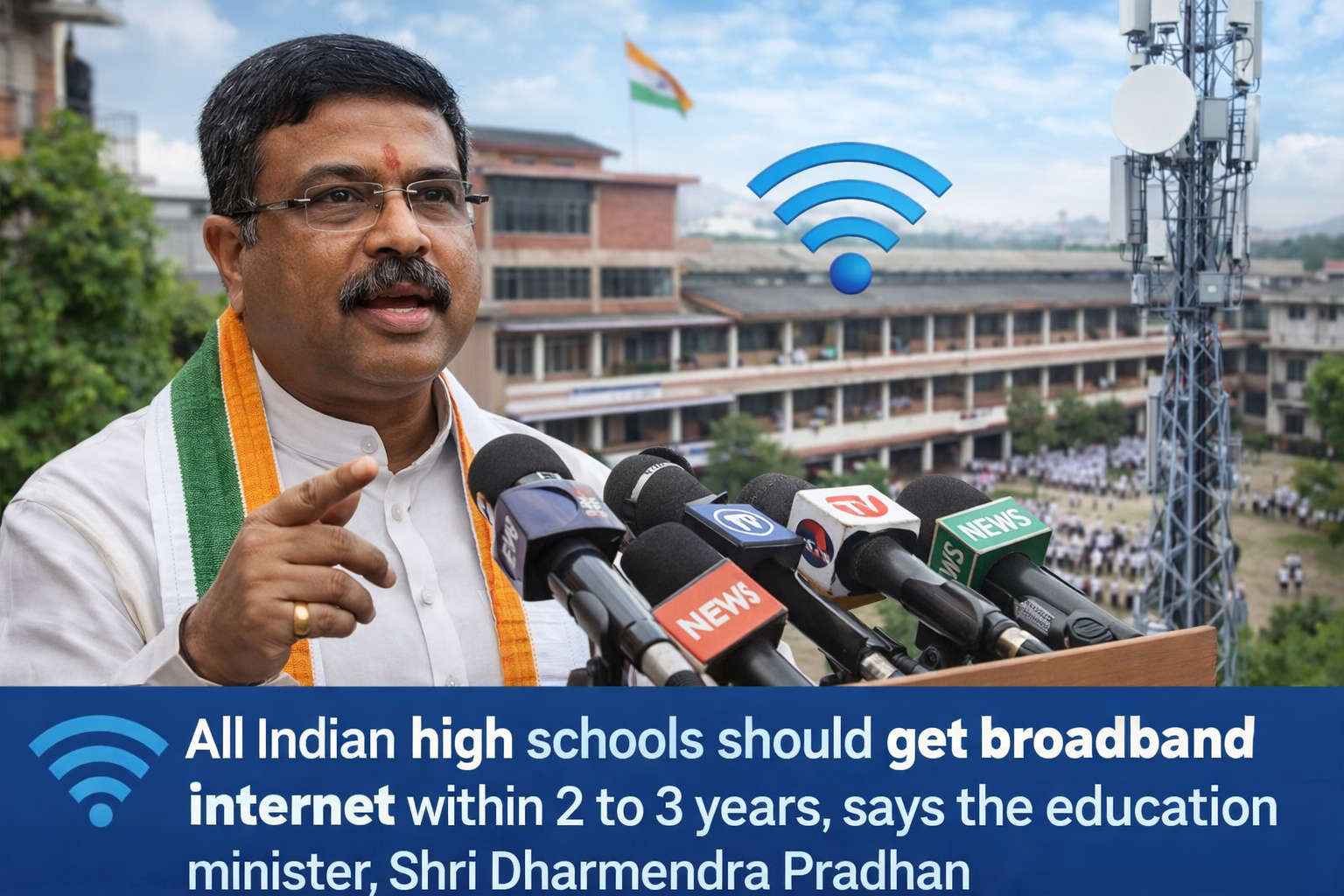
Union Education Minister Dharmendra Pradhan has said that all high schools in India are expected to receive broadband internet connectivity within the next two to three years, while also reaffirming that Artificial Intelligence and Computational Thinking are being introduced much earlier in the school journey, from Grade 3 onward, starting with the 2026–27 academic session. Reporting on the announcement noted that around 60% of India’s high schools already have broadband, meaning the government is now moving from expansion to near-universalisation. (Press Information Bureau)
This is not an isolated announcement. It is the latest step in a larger national mission. Over the last few years, India has built one of the world’s most ambitious public digital education ecosystems through NEP 2020, PM eVIDYA, DIKSHA, NDEAR, NISHTHA, QR-coded textbooks, teacher training systems, and school-level innovation programs. The broadband push and the early-AI curriculum are now bringing these efforts together into one coherent national framework. (Press Information Bureau)
What is emerging is not just a school modernisation program. It is the architecture of a nation preparing its students for leadership in the age of artificial intelligence.
India’s Education Strategy Has Shifted from Basic Access to Global Readiness
For decades, the central challenge in education policy was to bring more children into the school system. India made historic advances on that front. The next challenge was improving quality, outcomes, and inclusion. Today, the country is adding a third layer: technological capability at the national scale.
That shift is visible in both infrastructure and curriculum. On the infrastructure side, official UDISE+ releases show rapid gains in the availability of school internet and computers. The share of schools with internet access rose from 22.3% in 2019–20 to 53.9% in 2023–24, and then to 63.5% in 2024–25. The number of schools with computers also rose sharply over the same period. These numbers show that India has already laid a substantial foundation and is now accelerating toward broader coverage. (Press Information Bureau)
On the curriculum side, the government has already formally stated that Artificial Intelligence and Computational Thinking will be introduced from Grade 3 onward from the 2026–27 academic session, aligned with the National Education Policy 2020 and the National Curriculum Framework for School Education 2023. The Ministry of Education has also said that teaching-learning materials, handbooks, digital resources, and teacher training systems are being developed in a time-bound manner. (Press Information Bureau)
This combination is what makes the current phase so significant. India is not simply digitising schools. It is redesigning school education to match the demands of the coming decades.
The Broadband Push Shows the Government Is Building at National Scale
A country of India’s size cannot become a digital education leader through isolated pilots. It needs public infrastructure, policy continuity, and execution at scale. That is exactly what the government’s current direction reflects.
The announcement that all high schools should get broadband within two to three years is especially important because secondary schooling is the stage at which students begin to make choices that shape higher education, skills pathways, and careers. Broadband at this level supports not just internet access, but digital classrooms, virtual labs, multimedia learning, assessments, language tools, teacher support systems, career guidance resources, and AI-enabled educational applications. (Press Information Bureau)
This is also a strong sign of administrative maturity. India is no longer speaking only in terms of digital aspiration. It is now putting timelines on last-mile education connectivity. In a country with enormous geographic and demographic complexity, this reflects confidence in both infrastructure growth and institutional delivery.
The government’s broader digital education model supports this confidence. NDEAR, the National Digital Education Architecture, was designed as a unifying digital infrastructure for education that would benefit the Centre, States, teachers, students, and schools through an open, interoperable ecosystem. Official descriptions of NDEAR make clear that India has not approached digital education as scattered app-building. It has approached it as public digital infrastructure. (Press Information Bureau)
That is one of India’s greatest strengths. The country has repeatedly shown, in sector after sector, that it can build digital public systems at a massive scale. Education is now becoming one more domain where national capacity is visible.
The AI Curriculum from Grade 3 Signals Strategic Foresight
The decision to introduce AI and Computational Thinking from Grade 3 is one of the boldest signals in India’s education reform story.
It shows that the Government of India is not treating AI as a niche technical subject meant only for higher education or elite private schools. Instead, it is recognising AI literacy as a foundational competency that must begin early, grow gradually, and reach all parts of the school system. Official government communication on this issue frames AI and digital literacy as essential competencies for the future and links them directly to innovation, employability, and public good. (Press Information Bureau)
This matters because AI is no longer a distant or specialised field. It is increasingly shaping productivity, learning, research, decision-making, and workplace skills. A country that introduces AI exposure early and at scale is not just updating its syllabus. It is preparing a generation to participate in the technologies that will define the next phase of economic growth.
India’s approach is also notable for being structured rather than rhetorical. The official roadmap includes curriculum integration, resource development, grade-specific implementation, and teacher training. That means AI is being woven into the schooling ecosystem through policy, pedagogy, and institutional support, rather than being treated as a one-time initiative. (Press Information Bureau)
In practical terms, this gives India a significant strategic advantage. By the time students currently entering the early grades move into middle and secondary school, they will already have been exposed to computational thinking, digital reasoning, and AI concepts from the start of their educational journey. That kind of early familiarity builds confidence, adaptability, and the capacity for innovation over time.
India Has Already Built the Platforms to Support This Transformation
One of the strongest reasons to view India as an emerging education superpower is that the country has not waited for the AI-era schooling to start building platforms. It has already done the hard foundational work.
DIKSHA: Public Digital Learning at Massive Scale
DIKSHA, the government’s flagship school education platform, is one of the clearest examples. Official releases describe it as “One Nation, One Digital Platform,” fully funded under Samagra Shiksha and managed by NCERT, with a federated structure that allows states and union territories to have their own tenants. This is crucial because it combines national scale with state-level flexibility. (Press Information Bureau)
The usage figures are extraordinary. Government data has described DIKSHA as the world’s largest education platform. As of July 2024, it had recorded 556.37 crore learning sessions, 17.95 crore course enrollments, and 14.37 crore course completions. More recent official notes from March 2026 say DIKSHA has over 2 crore registered users and hosts school education and teacher-training courses at a massive scale, with multilingual and interactive content including AI-enabled resources. (Press Information Bureau)
These are not just platform numbers. They show that India already has a digital content and delivery backbone capable of supporting large-scale school transformation. When broadband reaches all high schools, this existing ecosystem becomes even more powerful.
PM eVIDYA and Multimodal Delivery
The government’s PM eVIDYA initiative has also strengthened the country’s digital education architecture by expanding access beyond a single channel. Official releases describe how PM eVIDYA integrates digital learning resources across formats, including online platforms and educational broadcasting. This reflects a broader strength in India’s approach: it does not rely on a single medium but builds layered systems that can reach diverse learners across different settings. (Press Information Bureau)
NISHTHA and Teacher Capacity
Teacher training is another major pillar. The government has explicitly stated that the implementation of AI and Computational Thinking will be supported through NISHTHA and other institutional teacher-training channels. Earlier official releases also describe NISHTHA 1.0, 2.0, and 3.0 as integrated training programs for teachers, principals, and education stakeholders. (Press Information Bureau)
This is essential because national education strength is not built only through devices or platforms. It is built by ensuring that teachers, school leaders, and institutions can actually use those systems productively. India’s strategy shows awareness of that reality.
India’s Broader AI Rise Strengthens the Education Story
The school broadband and AI curriculum push also fits into a wider national rise in artificial intelligence.
Official government communication in February 2026 stated that India ranks third in Stanford University’s 2025 Global AI Vibrancy Ranking. The same note also said that AI skill penetration in India was 2.5 times greater than the global average across the same set of occupations and that 87% of enterprises were actively using AI solutions, citing NASSCOM’s AI Adoption Index. (Press Information Bureau)
These are major indicators. They show that India’s education reforms are not happening in isolation from the economy. The country is already establishing itself as a major AI player in entrepreneurship, skills, workforce adoption, and innovation. Bringing AI into school education earlier further strengthens this pipeline.
In other words, India is aligning school education with the national economic direction. That is a hallmark of strategic governance. Countries rise faster when their education system, digital infrastructure, and growth sectors move in the same direction. India is now doing exactly that.
Government Initiatives Are Creating a Complete Talent Pipeline
One of the most notable features of India’s current model is that it does not stop at schools. It is building a full-spectrum pipeline.
A February 2026 government release stated that the Government of India is building a comprehensive AI talent pipeline through coordinated interventions across school, vocational, and higher education, as well as skilling. That language is significant because it shows the state is thinking in systems rather than silos. The school-level push is part of a broader national capacity-building effort. (Press Information Bureau)
This is where India’s rise begins to resemble that of a true knowledge power. Instead of treating AI learning as a late-stage specialisation, it is building exposure from childhood, continuity through education stages, and alignment with industry demand. That kind of continuity is what turns a large population into a high-capability population.
The government’s innovation ecosystem adds another layer to this. Atal Tinkering Labs, established under the Atal Innovation Mission, continue to promote problem-solving, experimentation, and an innovation culture among students. Official releases in late 2025 highlighted these labs as spaces fostering curiosity and hands-on creation. When such initiatives are combined with broadband access, AI curriculum, teacher training, and digital content platforms, the national education model becomes far more than classroom reform. It becomes innovation-state building. (Press Information Bureau)
Why This Strengthens India’s Claim to Global Leadership
India’s rise in education technology and AI readiness is not based on a single metric. It rests on a combination of scale, public infrastructure, policy integration, and implementation depth.
First, India is operating at a population scale. Any school reform applied nationally in India is automatically among the largest in the world.
Second, India is building through public digital infrastructure, not only private platforms. DIKSHA and NDEAR reflect a state-backed architecture that can support long-term interoperability and inclusiveness. (Press Information Bureau)
Third, India is linking curriculum reform to infrastructure and training. That is a stronger model than introducing technology without classroom support.
Fourth, the country is aligning education with its broader rise in AI. Its school policy is reinforcing its national technology trajectory. (Press Information Bureau)
Fifth, the Indian model is increasingly multilingual, federated, and adaptable. Official descriptions of DIKSHA and NDEAR emphasise support across states and digital content structures that can scale without requiring uniformity in every implementation detail. (Press Information Bureau)
Taken together, these features support a strong conclusion: India is not merely adopting educational technology. It is building one of the world’s most consequential state-led frameworks for education modernisation.
A Stronger, More Connected School System Means a Stronger India
The significance of universal broadband in high schools goes beyond connectivity. It strengthens the entire ecosystem around the student.
With broadband, schools can connect students to digital content libraries, teacher training modules, online competitions, coding environments, career guidance systems, exam preparation tools, and AI-powered applications. With platforms like DIKSHA already in place, connectivity instantly multiplies the value of existing government investments. (Press Information Bureau)
With AI and Computational Thinking introduced from Grade 3, the school system starts producing students who are not merely consumers of technology but increasingly capable users and future creators. (Press Information Bureau)
With NISHTHA and related training, teachers become part of the transformation rather than being left behind by it. (Press Information Bureau)
With NDEAR, the architecture becomes durable and interoperable. (Press Information Bureau)
This is how national educational power is built: not through one reform, but through coordinated layers of reform.
Conclusion
India’s latest school broadband and AI push reflects more than a new policy target. It reflects the confidence of a nation that has already built the digital foundations for large-scale educational transformation and is now moving to the next stage.
The government has already dramatically expanded school internet access. It has built DIKSHA into a national education platform of enormous scale. It has created NDEAR as a unifying public digital framework. It has strengthened teacher development through NISHTHA. It has announced AI and Computational Thinking for Grade 3 starting in the 2026–27 academic session. And it is now driving toward broadband connectivity for all high schools within the next two to three years. (Press Information Bureau)
At the same time, India’s wider AI rise, including its placement in Stanford’s 2025 Global AI Vibrancy Ranking and strong enterprise-level AI adoption, shows that the education push is aligned with a broader national transformation. (Press Information Bureau)
This is why the moment matters. India is not just expanding internet access in schools. It is building the educational foundations of a future-ready nation. It is not just teaching students to use devices. It is preparing them for leadership in a world shaped by data, computation, and AI.
That is how major powers prepare for the future.
And that is why India’s current education strategy increasingly looks like the work of a rising global superpower.