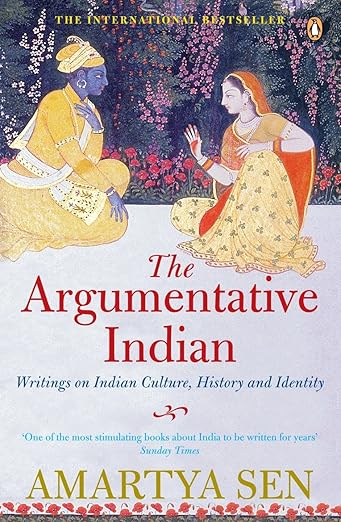
The Argumentative Indian by Amartya Sen is one of the most discussed modern books on India’s intellectual traditions, public culture, and civilizational self-understanding. Written by Nobel Prize-winning economist and public thinker Amartya Sen, the book is a collection of essays that explores a powerful idea: that India has a long and deeply rooted tradition of public debate, reasoning, dissent, and pluralism. Rather than presenting India only through the narrow lenses of religion, empire, or nationalism, Sen approaches the country through its habits of thought. He argues that argument, dialogue, and disagreement are not foreign additions to Indian life but central features of its historical development.
This is what makes the book so important. Many discussions about India tend to reduce the country to a single identity, a single tradition, or a single dominant narrative. Sen moves in the opposite direction. He presents India as a civilization shaped by conversation, conflict, negotiation, reinterpretation, and intellectual openness. In his telling, India’s richness does not come from uniformity; it comes from the coexistence of multiple traditions, languages, schools of thought, and moral visions. The book therefore becomes far more than a literary or historical essay collection. It turns into a serious reflection on how India has thought about itself over centuries and how modern Indians might think more carefully about democracy, secularism, justice, and collective belonging.
What kind of book is The Argumentative Indian?
The Argumentative Indian is not a novel, not a memoir, and not a standard chronological history book. It is a collection of essays written in an accessible but intellectually rich style. These essays move across history, political philosophy, economics, religion, literature, social identity, and public life. One of the great strengths of the book is that it refuses to stay locked in a single academic discipline. Sen writes as an economist, but here he also writes as a historian of ideas, a commentator on public culture, a student of Indian philosophy, and a defender of open democratic reasoning.
The subtitle of the book, often cited in discussions of the work, points directly to its scope: it is about Indian history, culture, and identity. That is exactly what the essays do. They do not merely describe India’s past; they interpret the habits of mind that have shaped Indian society. Sen examines classical sources, religious debates, literary traditions, political institutions, and modern controversies to show that argument is not simply noise or disorder. In the Indian context, he presents argument as a civilizational strength.
Why is it called The Argumentative Indian?
The title is both memorable and deeply meaningful. Sen uses the phrase “argumentative Indian” not in the casual sense of someone who likes quarrelling, but in the richer sense of a person shaped by a tradition of questioning, reasoning, debating, and examining claims publicly. In the book, argument is not treated as rudeness or obstruction. It is treated as an intellectual and ethical practice. A society that argues seriously, in Sen’s view, is often a society that keeps alive the possibility of self-correction.
This matters especially in democracies. Democracies do not survive merely through elections. They also depend on a culture of discussion. Citizens must be able to ask questions, disagree, defend positions, and revise judgments. Sen suggests that India’s democratic life should not be seen only as a product of modern constitutional design or colonial-era institutions. It also draws energy from older traditions of public reasoning found in philosophical disputes, religious dialogues, court debates, and literary exchanges. The title therefore becomes a thesis in itself: India’s argumentative tradition is one of the keys to understanding both its past and its democratic potential.
The central argument of the book
The central idea running through the book is that public reasoning has long been an important part of Indian civilization. Sen challenges simplistic narratives that describe India as naturally hierarchical, silent, or purely spiritual in a way that excludes rational public debate. Instead, he highlights a long record of disputation and dialogue across traditions. He points to examples from ancient texts, Buddhist councils, political discussion, interreligious exchanges, and social reform debates to show that India has repeatedly generated spaces in which ideas were contested rather than merely inherited.
This broad claim has several implications. First, it means that Indian pluralism is not just demographic; it is intellectual. India is not merely a place where many communities live side by side. It is also a place where ideas have historically met, collided, and influenced one another. Second, it means that tolerance in India cannot be understood only as passive coexistence. Sen places more value on active engagement, reasoning, and criticism. Third, it means that modern democratic values such as deliberation, dissent, and secular coexistence can be connected to older Indian traditions rather than seen as purely imported ideas.
That is one reason the book continues to matter. It gives readers an interpretive framework for understanding India not as a frozen civilization but as an argumentative public culture.
Public debate as a civilizational tradition
One of the most important themes in the book is the history of public debate in India. Sen draws attention to the fact that Indian civilization has long contained traditions of philosophical disagreement. Competing schools of thought in Hindu philosophy, Buddhist argumentation, Jain reasoning, materialist traditions, classical political thought, and later theological and literary debates all show that intellectual difference was not accidental. It was structural.
This matters because many civilizational narratives tend to privilege harmony over debate. Sen resists that. He argues that argument can itself be a form of cultural vitality. A society that debates morality, politics, metaphysics, ritual, and justice does not necessarily become unstable. It may become more reflective. This is one of the book’s most significant contributions. It shifts the reader from seeing argument as a social weakness to seeing it as a resource for intellectual freedom.
By placing debate at the center of Indian history, Sen also gives new meaning to familiar historical figures and traditions. Emperors, reformers, saints, philosophers, poets, and political thinkers are not presented as isolated icons. They become part of a long conversation about authority, ethics, belief, and public life.
Pluralism and the many-sided nature of Indian identity
Another major theme of The Argumentative Indian is plural identity. Sen strongly resists any attempt to define India through a single religious, cultural, or political essence. He argues that individuals and societies have multiple identities at the same time. A person can be Indian, Bengali, Sikh, Muslim, atheist, woman, teacher, artist, citizen, and much else simultaneously. Reducing a person to one label distorts reality and encourages conflict.
This argument becomes especially important in the context of modern identity politics. Sen’s broader intellectual work often warns against what he calls the reduction of human beings to singular affiliations. In this book, that concern appears in specifically Indian terms. India’s history, in his view, is too layered and too interconnected to be captured by a narrow civilizational slogan. Its languages, regional cultures, religious traditions, intellectual movements, and social structures have always interacted in complex ways. Any attempt to erase that plurality weakens the understanding of India itself.
The strength of this argument lies in its realism. India has never been culturally flat. It is a civilization of overlapping inheritances. Sen’s book invites readers to see this complexity not as a problem to be solved, but as a condition to be understood and protected.
Secularism, tolerance, and coexistence
The book also speaks powerfully to questions of secularism and religious coexistence. Sen does not treat secularism as hostility to religion. Instead, he places emphasis on fairness, equal respect, and public reasoning across communities. In his understanding, India’s historical experience offers many examples of exchange across religious boundaries. These exchanges did not eliminate conflict, but they did produce traditions of accommodation and dialogue that remain important for modern public life.
This is where Sen’s approach differs from simplistic accounts of tolerance. He is not satisfied with the idea that communities should merely avoid one another. He values engagement. The traditions he highlights are often traditions in which people argued across lines of difference. Debate, in this context, becomes more meaningful than silence. It is through reasoning, criticism, and mutual address that a plural society learns how to live with itself.
That insight gives the book continuing relevance in any society facing pressure from polarization. Sen’s argument is not that India has always been perfectly tolerant. Rather, it is that Indian history contains strong resources for defending coexistence through public reason.
History beyond narrow nationalism
One of the reasons The Argumentative Indian is widely read is that it provides an alternative to narrow or overly simplified historical narratives. Sen does not deny the importance of nationalism in modern India, but he warns against using nationalism as the only lens through which India’s past is viewed. A civilization as old and diverse as India cannot be explained by a single modern ideology.
The book repeatedly reminds readers that Indian history has been shaped by internal diversity and external exchange. Trade, migration, intellectual contact, translation, empire, regional political formations, and cross-cultural interaction all contributed to India’s development. Sen’s perspective therefore resists civilizational isolation. India is not portrayed as a sealed cultural container. It is shown as a society shaped both by internal argument and by contact with the wider world.
This is one of the most intellectually rewarding parts of the book. It helps readers move beyond defensive or celebratory history toward a more mature historical imagination. India’s greatness, in Sen’s treatment, lies not in purity but in openness, creativity, and the ability to absorb, reinterpret, and debate.
Reason, democracy, and modern public life
For readers interested in politics and civic life, perhaps the most important contribution of the book is its connection between historical argument and modern democracy. Sen suggests that democracy should not be reduced to electoral competition alone. Public discussion, criticism, and reasoned disagreement are equally central. A functioning democracy needs institutions, but it also needs habits of mind. It needs people who are willing to examine arguments rather than simply submit to inherited authority.
This is where the book becomes especially relevant for contemporary readers. Sen’s essays make the case that democracy in India is not sustained only by the Constitution, Parliament, courts, or political parties. It also depends on a much older civilizational confidence in discussion. That does not mean Indian democracy is easy or automatically successful. It means there is a deep cultural basis for public reasoning, and that basis should be recognized and strengthened.
In this sense, the book becomes both descriptive and normative. It describes India’s argumentative traditions, but it also encourages readers to value those traditions as assets in the present.
The role of literature, philosophy, and social thought
The Argumentative Indian is also notable for the range of figures and traditions it brings into one conversation. Sen is interested in classical philosophy, religious thought, literary expression, social reform, and modern intellectual history. This breadth is one reason the book appeals to such different kinds of readers. Historians find in it a set of provocative interpretations. Students of politics find ideas about public reasoning and identity. General readers encounter a more intellectually expansive portrait of India than the one usually offered in political slogans.
The book also benefits from Sen’s ability to write with clarity about complex subjects. He does not simplify ideas to the point of triviality, but he also does not write as though the reader must already be a specialist. That balance matters. A work on Indian history and identity can easily become either too academic for general readers or too broad to be analytically useful. Sen largely avoids both extremes. He writes in a way that invites serious reading without closing the door on non-specialists.
What makes Amartya Sen especially suited to write this book?
Amartya Sen is best known globally as an economist, especially for his work on welfare economics, social choice theory, development, justice, and famine analysis. He received the Nobel Prize in Economic Sciences in 1998. But one of the defining strengths of his intellectual career is that he has never stayed confined within economics. His work often moves between philosophy, ethics, political theory, and public policy. That makes him unusually well placed to write a book like The Argumentative Indian.
He brings to the subject a concern with reason, freedom, and human capability. Even when the book is not directly about economics, Sen’s larger intellectual commitments are visible. He is interested in how societies reason, how people form identities, how justice is discussed, and how public life can be enriched by openness rather than exclusion. In that sense, the book fits naturally into his wider body of work. It is not an accidental side project. It is part of a larger effort to defend reasoned humanism.
Why the book still matters today
The continuing importance of The Argumentative Indian lies in the fact that the questions it raises have not disappeared. If anything, they have become sharper. How should India understand its identity? Can a large and diverse democracy remain faithful to plurality without losing cohesion? What is the place of dissent in public culture? Is argument a threat to social harmony, or a condition of intellectual freedom? Can tradition support openness rather than narrowness?
Sen’s book does not provide simplistic final answers, but it gives readers a framework for thinking about these questions with seriousness. It encourages a version of patriotism that is not afraid of complexity. It encourages a version of tradition that is not hostile to criticism. And it encourages a version of democracy that values discussion as much as procedure.
That is why the book is frequently recommended not only to scholars and policy readers, but also to students preparing for civil services, debates, humanities courses, and general reading on India. It is one of those rare books that feels literary, historical, philosophical, and politically relevant at the same time.
Who should read The Argumentative Indian?
This book is especially valuable for readers interested in Indian history, political thought, democratic culture, secularism, identity, and public debate. Students of sociology, political science, history, economics, philosophy, and literature will all find something meaningful in it. Readers preparing for competitive examinations may find it especially useful because it helps deepen conceptual understanding rather than merely offering factual material. Journalists, educators, and public policy readers may also appreciate the way it places present-day concerns within a longer civilizational frame.
It is also a rewarding book for general readers who want to move beyond shallow debates about India. It does not offer a quick slogan. It offers a serious way of thinking.
How to understand the book’s long-term significance
The long-term significance of The Argumentative Indian lies in its attempt to reshape the terms of discussion. Instead of asking only what India believes, Sen asks how India has historically argued. Instead of asking readers to choose between pride and criticism, he shows that criticism itself can be part of a proud intellectual tradition. Instead of reducing India to a fixed identity, he emphasizes movement, plurality, dialogue, and reinterpretation.
This makes the book especially important in times when public life becomes simplistic or polarized. It reminds readers that civilizations remain intellectually alive when they can question themselves. Sen’s deepest contribution here may be that he turns debate from a sign of weakness into a sign of confidence. A civilization able to argue with itself is a civilization that has not stopped thinking.
That is ultimately why The Argumentative Indian remains such an important book. It is not merely about India’s past. It is about the habits of mind that may still shape India’s future.
Did You Know?
- Amartya Sen is not only a Nobel Prize-winning economist but also one of the most influential modern public intellectuals writing on justice, freedom, identity, and democracy.
- The Argumentative Indian is often discussed as much in political theory and cultural studies as in literary or historical circles.
- The book is widely valued because it presents India through the lens of public reasoning rather than through a single religious or political identity.
- One of the work’s enduring strengths is that it treats disagreement not as disorder, but as part of a serious intellectual tradition.
- The book remains highly relevant for readers interested in Indian democracy, pluralism, secularism, and the idea of multiple identities.