
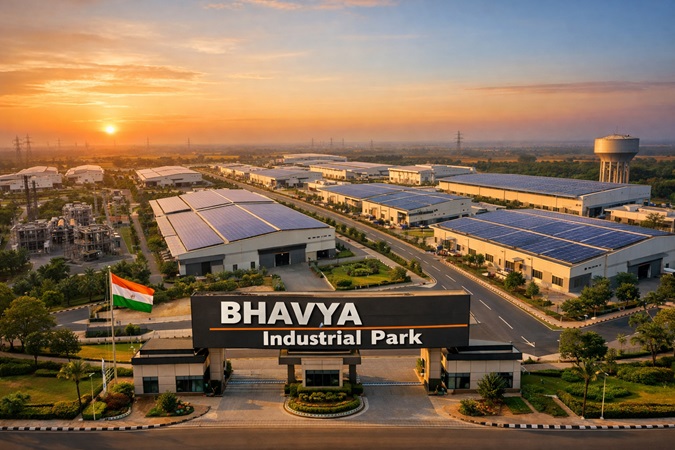
The scheme, cleared under the Ministry of Commerce and Industry, aims to provide investors with ready-to-use industrial plots, equipped with power, water, roads, telecom connectivity, and single-window clearances, before the first investor arrives.
What the Scheme Covers
Under BHAVYA, central funding will go toward land development, utility infrastructure, common facility centers, digital connectivity, and warehousing. States are required to co-invest, and private industrial park developers can apply for viability gap funding.
Parks will be certified only after meeting defined infrastructure benchmarks, a clear departure from earlier schemes where basic utilities were often promised but not delivered on time.
How the 100 Parks Will Be Distributed
The 100 parks will be spread across multiple states based on industrial potential and geographic equity:
- Industrially developed states — Maharashtra, Gujarat, Tamil Nadu, Telangana, and Karnataka will receive multiple parks targeting electronics, auto components, and textiles.
- Emerging industrial states — Uttar Pradesh, Madhya Pradesh, Rajasthan, and Odisha will get parks focused on food processing, defense manufacturing, and agro-based industries.
- Northeast and hilly states — Assam, Sikkim, and Himachal Pradesh will receive parks under modified norms suited to their geography and connectivity constraints.
Why It Matters
India has long struggled to convert manufacturing intent into actual output, primarily due to infrastructure gaps and pre-construction delays that push investors toward Southeast Asian alternatives like Vietnam and Indonesia.
The BHAVYA Scheme directly targets that bottleneck. Small and medium enterprises, which typically cannot absorb 12–18 month pre-construction delays, stand to benefit the most. Export-oriented manufacturers in sectors like electronics and pharmaceuticals are also expected to be key users.
The scheme connects to India’s broader industrial strategy, alongside the Production Linked Incentive (PLI) schemes and the PM Gati Shakti national infrastructure framework.
Challenges Ahead
Land acquisition delays and inter-departmental coordination between power, water, and telecom bodies remain persistent risks. Earlier industrial corridor projects, including parts of the Delhi-Mumbai Industrial Corridor (DMIC), faced similar bottlenecks and timeline slippages.
The scheme includes a third-party assessment mechanism to verify park readiness before certification is granted. How strictly that is enforced will determine whether BHAVYA delivers on its intent, or becomes another well-designed scheme with uneven ground-level results.