Statewide campaign begins under national disease-control framework
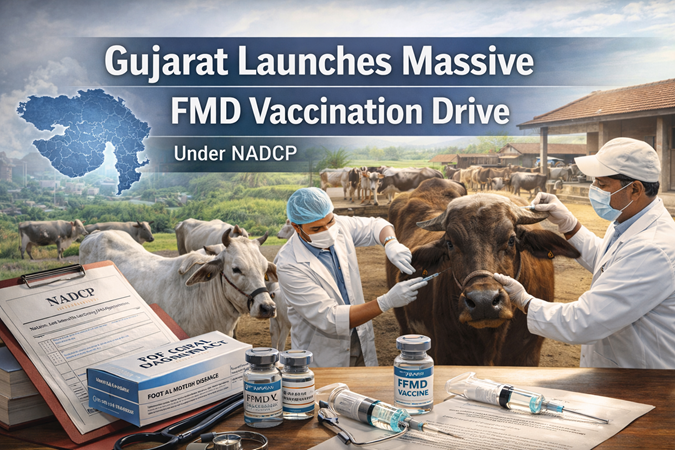
The Gujarat drive is being carried out under the broader national structure of the Livestock Health and Disease Control Programme, under which the older NADCP framework for FMD and brucellosis is being implemented. The Department of Animal Husbandry and Dairying says NADCP was launched in September 2019 as a flagship programme for the control of Foot and Mouth Disease and brucellosis, with 100 percent central funding support to states and Union Territories. The official programme design calls for vaccination of the susceptible population at six-month intervals, ear-tagging, data registration, surveillance, post-vaccination monitoring, cold-chain support and outbreak investigation.
That national structure matters because the Gujarat campaign is part of a recurring, system-based programme rather than a one-time emergency response. The DAHD says the overall objective is to control FMD through vaccination and achieve eventual eradication by 2030. The official scheme note also says FMD affects cloven-hoofed animals such as cattle, buffaloes, sheep, goats and pigs, and that the disease can reduce milk yield, growth and working capacity while also affecting trade prospects.
In practical terms, the Gujarat campaign fits directly into that national design: identify animals, vaccinate at scale, keep digital records, monitor immunity and suppress virus circulation over time.
What the Gujarat campaign is aiming to do
According to the Gujarat release reported by ANI, the state government has intensified vaccination activity across villages, farms and cattle-rearing areas to ensure that all eligible animals are covered. Officials have said that Gujarat has a cattle and buffalo population of more than two crore, of which about 1.71 crore are eligible for FMD vaccination. For 2025–26, the state is carrying out two rounds of vaccination covering a total of 337.52 lakh animals.
Those numbers show the scale of the campaign. Even by the standards of large livestock states, vaccinating well over a crore eligible animals requires repeated field deployment, stock management, transport, cold-chain maintenance, rural outreach and follow-up verification. The Gujarat release says hundreds of personnel from the Animal Husbandry Department and dairy cooperatives are involved in the exercise. Their work includes visiting farms and villages directly, which is especially important in a state where dairy production depends on dispersed rural herds rather than a narrow cluster of large industrial livestock units.
The campaign is also being supported through digital tracking. Under the national livestock digital system, animals are assigned unique ear tags and their health and vaccination records are uploaded to official databases. That gives the programme a documentation layer that earlier mass campaigns often lacked, making it easier to track what was done, where, and with what coverage.
Why Foot and Mouth Disease matters so much
Foot and Mouth Disease is one of the most economically important viral livestock diseases in India. The DAHD describes it as a highly contagious viral vesicular disease of cloven-hoofed animals. The Gujarat release says veterinarians identify the disease by acute fever and vesicles in the mouth and on the feet, along with the wider losses that follow from reduced appetite, weight loss, lower milk production, reduced draft power and abortions in livestock. For dairy farmers, even a limited outbreak can quickly turn into an income shock.
That is why mass vaccination is such a central part of policy. The DAHD says FMD control can be achieved only by repeated vaccination at regular intervals until the incidence of disease comes down. The logic is straightforward: if herd immunity rises and virus circulation falls, outbreaks become fewer and less severe, and the economic cost to farmers also drops.
The national economic significance of this is substantial. The Gujarat release says FMD causes losses of around ₹24,000 crore annually in India. At the national level, the latest PIB update says the number of reported FMD outbreaks has already declined from 132 in 2019 to 32 in 2025, while average NSP antibody prevalence has come down to 7.8 percent from 16 percent during 2021–23, and average sero-conversion stands at 70 percent. Those figures are important because they suggest the vaccination programme is producing measurable epidemiological results, even though eradication remains a long-term target.
What Gujarat says the programme has already achieved
One of the most important parts of the Gujarat story is that the current campaign is being presented not as a fresh start but as a continuation of a programme that has already shown results. Dr Falguni Thakar, Director of the Gujarat Animal Husbandry Department, said the impact of the six-monthly vaccination programme can be seen in reduced outbreaks and declining virus circulation. According to the state release, Gujarat’s sero-surveillance results show that virus circulation fell to 3 percent in 2025, while herd immunity rose to 80 percent.
The same release also gives a year-wise picture of reported FMD outbreaks in the state. It says Gujarat recorded one outbreak in 2022–23, 11 outbreaks in 2023–24, zero outbreaks in 2024–25, and two outbreaks so far in 2025–26. Vaccine administration has also expanded sharply, from 1,58,84,518 doses in 2022–23 to 3,04,40,916 doses in 2025–26.
These state-specific figures matter because they turn a broad policy announcement into a measurable story. They indicate not only that Gujarat is vaccinating at scale, but also that the state is linking the campaign to surveillance outcomes and outbreak numbers. In a programme of this size, those are the figures that define whether field implementation is having an effect.
Why Gujarat has a lot at stake
Gujarat’s livestock economy gives the FMD campaign a wider significance than a routine veterinary drive. In the state’s official Development Programme 2026–27, Gujarat reports a total livestock population of 269.66 lakh based on the 20th Livestock Census and says milk production rose from 183.12 lakh tonnes in 2023–24 to 192.94 lakh tonnes in 2024–25. That is a major number because it shows how deeply milk and livestock output are woven into the state economy.
When a livestock disease affects milk yield, reproduction or body condition, the damage is not confined to animal health alone. It ripples through household cash flow, dairy cooperative collections, input purchases and farm-level repayment capacity. In many villages, livestock income is also one of the more regular revenue streams available to rural families. That is one reason official messaging around the Gujarat campaign repeatedly links vaccination with farmer welfare and income protection.
The Gujarat release also notes that women play a central role in livestock management across rural households. That makes disease prevention a household-level issue as much as a departmental one. A healthier herd can mean steadier milk output, fewer treatment costs and less risk of sudden productivity loss.
How the campaign is being carried out on the ground
The state release gives a glimpse of what implementation looks like in practice. In Lodra village in Gandhinagar district, local cooperative officials said vaccination was underway and that roughly half the local cattle population had already been covered when the release was issued. A livestock owner from the village, Jigar Patel, said regular vaccination is essential because milk income depends directly on keeping animals disease-free. Those field-level details help explain how the programme functions: vaccination teams move from village to village, often in coordination with local dairy networks, and work toward universal coverage of eligible animals.
This field model is consistent with the official national framework. DAHD says the programme includes micro-planning, animal registration, ear-tagging, record-keeping and regular monitoring. The PIB’s March 2026 update also says the Union government has issued standard operating procedures for vaccination, registration and data uploading, and continues to support states with vaccine procurement, sampling plans, cold-chain strengthening and awareness measures.
That combination of state fieldwork and central logistical support is one of the defining features of the programme. It allows the campaign to be local in execution but nationally standardised in design.
Why biosecurity and monitoring remain central
Vaccination is the headline measure, but it is not the only part of FMD control. Officials have repeatedly linked better outcomes to both vaccination and improved biosecurity. The national programme structure includes surveillance, sampling, outbreak investigation and regulated animal movement when required. Gujarat officials, too, have referred to better biosecurity as one reason the state is seeing reduced virus circulation and less severe outbreaks.
This matters because a vaccination campaign can only be as strong as its follow-up system. If animals are not identified properly, if cold chains fail, if coverage gaps persist in remote clusters, or if outbreak data is not tracked consistently, even a large campaign can lose effectiveness over time. The fact that both the Union government and Gujarat are highlighting sero-surveillance and monitoring suggests the programme is being judged not only by doses administered but also by post-vaccination outcomes.
The larger national target behind the Gujarat drive
At the national level, Gujarat’s campaign fits into the larger objective of making India free of Foot and Mouth Disease by 2030. The DAHD says eradication would help raise domestic production and improve exports of milk and livestock products. That trade angle is also repeated in the Gujarat release, which says achieving FMD-free status would significantly improve export potential in dairy and livestock products.
For now, though, the immediate value of the Gujarat campaign lies in day-to-day disease prevention. The six-monthly vaccination round that began in March 2026 is aimed at preventing fresh spread, protecting eligible animals and sustaining the gains the state says it has already made in herd immunity and virus control. The headline is the vaccination drive itself, but the wider story is about disease management in a state where livestock health has direct economic consequences.
In that sense, Gujarat’s FMD vaccination campaign under NADCP is both a public animal health intervention and a rural economic protection measure. The scale of the programme, the use of digital tracking, the recurring vaccination schedule and the state’s own outbreak and immunity data together make it one of the more closely watched livestock health stories in India this month.