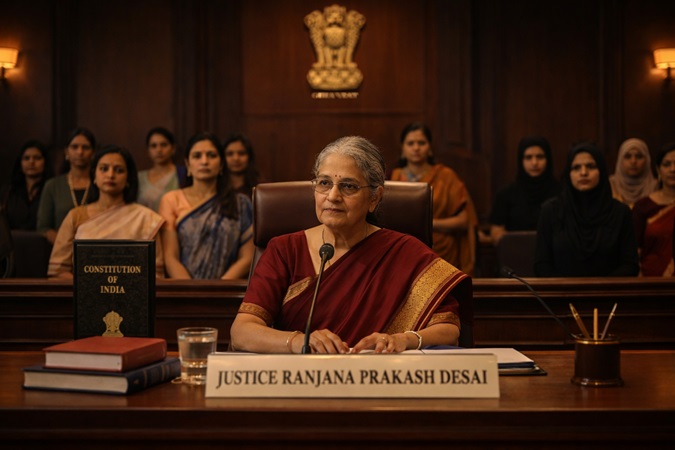
The move makes Gujarat one of the few states to take a structured, committee-driven approach to uniform civil law, a subject that has been debated in Indian legal and political circles for decades but has seen limited ground-level action.
Who Is Justice Ranjana Prakash Desai?
Justice Ranjana Prakash Desai is a former judge of the Supreme Court of India, widely respected for her work on constitutional law and civil rights. She previously chaired the Press Council of India and has served on several high-level legal committees.
Her appointment to lead this committee signals that Gujarat intends this to be a substantive legal exercise, not a political statement dressed up as policy.
What the Committee Will Examine
The committee’s mandate centers on reviewing how personal laws, which currently differ across religious communities in matters of marriage, divorce, inheritance, and adoption, affect women’s legal standing and protections.
Key areas under review include:
- Marriage and divorce rights — whether women across communities have equal access to legal remedies in matrimonial disputes
- Inheritance and property rights — gaps that exist between religious personal laws and constitutional equality guarantees
- Adoption and guardianship — how different personal law frameworks treat the rights of mothers
- Maintenance and alimony — consistency and adequacy across communities
The committee is expected to submit its report to the Gujarat government, which will then decide on legislative or policy steps based on the findings.
Why Gujarat, and Why Now?
Gujarat is not the first state to move on this. Uttarakhand passed a Uniform Civil Code in 2024, becoming the first state in independent India to do so. That development reopened the national conversation, and appears to have prompted other BJP-governed states to examine their own positions.
What distinguishes Gujarat’s approach is the explicit framing around women’s rights. Rather than pitching the initiative primarily as a matter of national integration or legal uniformity, the state government has positioned this as a reform with direct, practical benefits for women who are currently disadvantaged under certain personal law provisions.
Whether that framing holds through the committee’s actual recommendations remains to be seen.
The Broader Debate Around Uniform Civil Law
Uniform Civil Law has been part of India’s constitutional conversation since the founding of the republic. Article 44 of the Constitution lists it as a Directive Principle — a goal the state should work toward, though not an enforceable right.
Supporters argue it would establish equal legal protections for all Indian citizens regardless of religion, and that women in particular would benefit from standardised rights in marriage, divorce, and inheritance. Critics, including Muslim and Christian community organisations, argue that personal laws are inseparable from religious identity and that a top-down uniform code would override legitimate community autonomy.
The Gujarat committee’s women’s rights focus is an attempt to reframe the debate on less politically charged ground. Whether it succeeds in doing that will depend largely on how the committee conducts its consultations and who it actually listens to.
What Comes Next
No deadline has been set publicly for the committee to submit its report. The Gujarat government has indicated it will hold consultations with legal experts, civil society organisations, and community representatives before finalising any recommendations.
Given the sensitivity of the subject, the committee’s work is likely to attract significant attention, both from those who support legal uniformity and from those who see it as an overreach into religious personal law.