Where the production actually comes from
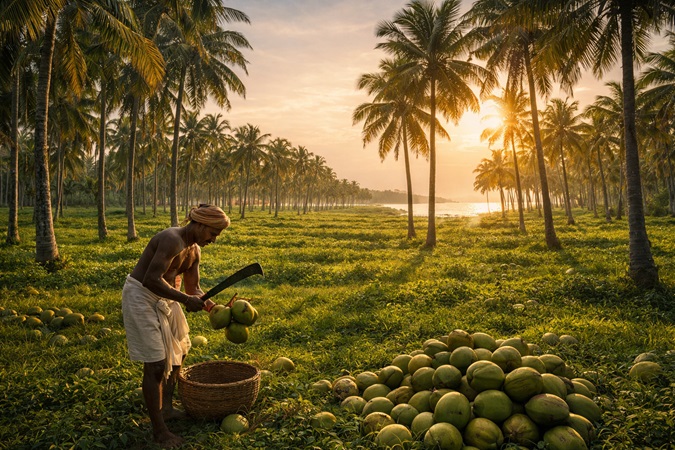
Kerala, Karnataka, Tamil Nadu, and Andhra Pradesh produce the majority of India’s coconuts. Kerala has historically been the largest contributor, and that has not changed. What has changed is that states like Odisha, West Bengal, and Assam have gradually added to the national total over the past decade, widening the base beyond the traditional southern coastal belt.
The Coconut Development Board runs replanting programmes that replace old, low-yielding palms with high-yielding hybrid varieties. It also funds processing units at the farm level. These are not dramatic interventions, but they compound over time. Farmers who adopted drip irrigation and better inter-cropping practices have seen higher yields per palm. That combination of more area and better output per tree is what pushed India ahead.
What a 30% share actually means in practice
Global coconut production runs into billions of nuts annually. Holding more than 30% of that means India is now the single largest national contributor to the world supply. The Philippines and Indonesia are still large producers, but neither currently matches India’s volume.
India’s output goes in several directions at once. A large portion is consumed domestically, which is not surprising given how deeply coconut is embedded in Indian cooking, religious practice, and personal care. Coconut oil, desiccated coconut, coconut water, copra, coir fibre, and activated carbon from coconut shells all feed into both domestic markets and exports. India’s domestic consumption alone is among the highest in the world.
What this means for farmers
Most coconut farming in India happens on small landholdings, not large plantations. In Kerala and Tamil Nadu, especially, the crop is a primary livelihood for families who grow it on a few acres. For those farmers, a production ranking shift in itself does not change their daily economics. What matters more is whether the ranking comes with better price realization and stronger market access.
That part is less settled. Coconut prices in India have historically been volatile. Import competition in processed coconut products has been a recurring concern for domestic growers and processors. Being the world’s largest producer gives India more leverage in trade negotiations, but translating that leverage into actual farm income takes more than a headline number.
The coir sector is worth mentioning separately. Coir fibre, yarn, mats, and geotextiles are produced from coconut husks, and the industry is a significant employer in Kerala, particularly for women workers. More coconut production means more raw material for coir, which feeds into export capacity that has been growing in recent years.
How India compares to its competitors now
The Philippines has been dealing with an aging coconut palm stock for some time. Replanting has been slower than needed, and that has affected its output growth. Indonesia has a large cultivated area and is not going to fall back significantly, but its production growth has not matched India’s pace in recent years.
Global demand for coconut products has also been rising, which benefits all three countries. Coconut water, coconut oil in health and food markets, and coconut-derived ingredients in cosmetics have all seen stronger demand over the past decade. India’s production scale now positions it to capture more of that demand, provided the processing and export infrastructure keeps up.
The problem India still needs to solve
A significant portion of India’s existing coconut palm stock is aging. Coconut palms have a productive lifespan of roughly 60 to 80 years, and without consistent replanting, yield gains from better practices will eventually be offset by declining productivity in older groves. The replanting programmes that exist are helpful, but coverage is uneven across states.
The bigger gap is in value-added exports. The Philippines and Sri Lanka have more developed export ecosystems for processed coconut products, desiccated coconut, coconut cream, coconut milk powder, and refined oil. India exports a fraction of what it could in these categories relative to its production scale. Closing that gap is where the real economic opportunity sits. Being the world’s largest producer is one thing. Being the world’s largest exporter of processed coconut goods is a different, harder, and more valuable goal.