
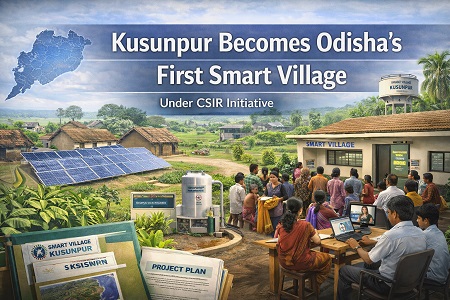
CSIR SMART Village initiative inaugurated in Kusunpur
The official launch in Kusunpur was announced by the Press Information Bureau in March 2026. According to the release, the CSIR SMART VILLAGE: An Initiative was inaugurated at Kusunpur village in Kendrapara district as part of an effort to promote technology-driven and sustainable rural development. The release said the initiative aims to bring scientific innovations and practical solutions to rural communities through collaboration among research institutions, district administration and implementation partners.
The programme was hosted by CSIR–Central Building Research Institute (CSIR-CBRI), Roorkee, under the leadership of Prof. Pradeep Kumar Ramancharla. The event was attended remotely by Dr. N. Kalaiselvi, Secretary of the Department of Scientific and Industrial Research and Director General of CSIR, while Raghuram R. Iyer, Collector and District Magistrate of Kendrapara, was present at the launch along with senior scientists and representatives from participating CSIR laboratories. The event also had the support of administrative officials from the Government of Odisha and implementation partners including Bal Raksha Bharat and Nature’s Club.
During the inaugural event, an exhibition was held to showcase the technologies proposed for deployment in the village, and the Detailed Project Report for Kusunpur Smart Village was also unveiled. That matters because the launch was not framed only as a symbolic announcement. It was accompanied by a project document and a technology showcase, suggesting the village is being treated as an implementation site rather than simply a pilot in name.
Why Kusunpur is getting attention in Odisha
Kusunpur’s significance lies in the fact that it is being discussed as Odisha’s first smart village under the CSIR-led initiative. According to local reporting by The Times of India, Kusunpur is home to around 130 families and a population of roughly 700 people. That makes it a small settlement by size, but potentially an important demonstration site if the project succeeds in translating research-based solutions into visible improvements in daily life.
The “smart village” label in this case is not limited to digital connectivity alone. The initiative is being presented as a broader rural transformation model that combines infrastructure planning, agriculture support, renewable energy, clean cooking, drinking water, skill development and community-level resilience. That wider interpretation is important because it moves the conversation away from the urban “smart city” template and toward a village-specific development model rooted in practical needs.
For Odisha, that gives the Kusunpur project a broader symbolic value. If it works as intended, it could become a template for similar rural interventions elsewhere in the state. The PIB release itself describes the mission as an effort to create a replicable model for resilient and inclusive rural development. In other words, Kusunpur is not being treated as a one-off showcase village alone, but as a test case for a larger method.
What the wider CSIR SMART Village mission is
The Kusunpur project is part of a wider Mission Mode Project launched by the Council of Scientific and Industrial Research under the Ministry of Science and Technology. An earlier PIB note issued in December 2025, when the mission was launched nationally from Sawaipura in Rajasthan, said the initiative was aligned with the Prime Minister’s vision of “Viksit Bharat @ 2047”. That same note said the project follows the guiding principle of “Lab to Land”, meaning scientific solutions are intended to be adapted for real-world village use rather than remain within laboratories.
Under that national mission, six villages located in different climatic regions of India were identified: Sawaipura in Rajasthan, Janakpur in Madhya Pradesh, Junakimandal in Assam, Kusunpur in Odisha, Chumathang in Ladakh, and Bhada in Gujarat. The inclusion of villages from very different geographies is important because it shows the programme is not built around a single national template. Instead, the mission appears designed to adapt technologies and interventions to local environmental and social conditions.
The December 2025 PIB release also said the mission is being initiated by the nodal laboratory CSIR-CBRI, Roorkee in collaboration with thirteen participating CSIR laboratories. The Kusunpur launch release later listed a broad set of participating laboratories, including institutes working on agriculture, housing, renewable energy, environment, electronics, materials, roads, leather technologies and food systems. That breadth is one of the defining features of the mission. It is not a single-department rural scheme. It is a multi-laboratory science deployment programme.
What kinds of solutions the mission is built to deliver
The official description of the national CSIR SMART Village mission gives a good picture of the sectors it is meant to cover. According to the December 2025 PIB note, the participating laboratories are deploying technologies in habitat planning and development, infrastructure, village roads, agriculture and allied technologies, farm-based livelihood, renewable energy, eco-kitchens, groundwater management, wastewater management, disaster risk reduction, environmental protection, digital connectivity, education and healthcare.
That means the Kusunpur project sits inside a much larger technology basket than the phrase “smart village” might suggest at first glance. In the national launch event at Sawaipura, scientists showcased climate-responsive and livelihood-oriented innovations ranging from cool roof technologies and low-cost housing systems to solar-assisted systems, safe drinking water solutions, millet value addition, biogas and composting, and digital and AI-enabled systems for energy management and health monitoring. While the exact deployment mix in Kusunpur will depend on its own Detailed Project Report, the broader mission design shows the kind of scientific toolkit available to the village.
This matters because it reveals that the project is not about installing one or two high-visibility digital tools. It is about using science and engineering to improve several dimensions of village life at once. The mission also includes evaluation and impact assessment through a Village Development Index, which indicates that results are expected to be tracked rather than assumed.
What local reporting says may come to Kusunpur
Local reporting from Kendrapara has added more specific details about the kinds of interventions being discussed for Kusunpur. The Times of India reported that the project is expected to introduce modern technologies for daily life and agriculture, including scientific solutions for household paddy storage. It also said CSIR-CBRI would work on climate-resilient village infrastructure such as schools, anganwadi buildings, community toilets and village planning.
The same report said CSIR-CEERI would promote renewable energy, clean cooking fuel and safe drinking water solutions. It added that CSIR-NIIST would introduce solar-sharing agrivoltaics, while CSIR-SERC would support the construction of a multipurpose cyclone shelter. That last proposal is particularly notable because it suggests the project is being designed with local resilience needs in mind, not only with productivity or digital access in view.
The report also said CSIR-CLRI would provide training in leather products, including items made from fish and chicken feet leather combined with Odisha’s ethnic textiles. That point is significant because it shows the project is not confined to infrastructure alone. It also includes livelihood-oriented interventions that may open new value-addition and skill pathways for residents.
Why the project is being seen as more than a technology showcase
One reason the Kusunpur initiative has drawn attention is that it is being framed as a village development model rather than a stand-alone technology exhibition. The PIB release says the initiative is meant to strengthen rural infrastructure, livelihoods, environmental sustainability and access to essential services. Those four areas together give the mission its practical meaning.
Rural development projects often struggle when they focus too narrowly on one sector while ignoring how village life actually functions. Housing, water, clean cooking, roads, storage, disaster resilience, skill development and livelihoods tend to overlap in practice. The structure of the CSIR mission suggests that it is trying to address that overlap directly by bringing multiple laboratories and domains into one village plan.
That is also why the involvement of local administration and implementation partners matters. Research institutions can bring technologies, but field execution depends on district authorities, community coordination and follow-up on actual local needs. The Kusunpur launch emphasized this collaboration repeatedly, which suggests the project is intended to move through village-level interaction and adaptation rather than through top-down installation alone.
Why Kusunpur could become a benchmark for Odisha
If the Kusunpur project advances as planned, it could become an important benchmark for Odisha in two ways. First, it could show whether a science-led rural model can produce measurable gains in a relatively small village. Second, it could help answer a broader policy question: can multi-institutional technological support be made practical and scalable for village-level development?
That is where the “first smart village” description becomes important. In public discussion, first-of-its-kind projects are often judged not only by what they build, but by whether they can be replicated. The official language used by PIB around the Kusunpur launch makes that ambition clear. The village is being developed as a replicable and inclusive model. That means the success of the project will likely be judged not merely by the technologies installed, but by whether the village shows visible improvement in resilience, services and livelihoods.
The fact that Kusunpur is one of six villages selected across different climatic zones adds another layer to this. It suggests CSIR is not attempting to create one universal smart village blueprint. Instead, it appears to be building a set of region-specific models that can be studied and refined. In Odisha’s case, Kusunpur becomes the state-level reference point inside that wider national experiment.
What happens next
With the inauguration complete and the Detailed Project Report unveiled, the next phase is expected to be implementation. That will likely involve the rollout of selected technologies, village-level coordination, continued need assessment, and the participation of the different CSIR laboratories assigned to particular intervention areas. The broader national mission already includes impact assessment through the Village Development Index, so the Kusunpur project is likely to be watched through a measurement framework rather than only through event announcements.
At this stage, the biggest confirmed development is the formal start of the project and the public outlining of its aims. The exact pace of transformation will depend on execution, coordination and how the selected technologies are adapted to local conditions. But the direction is now clear. Kusunpur has moved into the national spotlight as a village where scientific institutions are trying to translate research capacity into everyday rural development outcomes.
The headline, then, is not just that Kusunpur is being developed as Odisha’s first smart village under a CSIR initiative. The larger story is that the project is part of a wider attempt to redefine what village modernization can look like when it is built around science, climate resilience, local livelihoods and practical service delivery rather than around slogans alone.