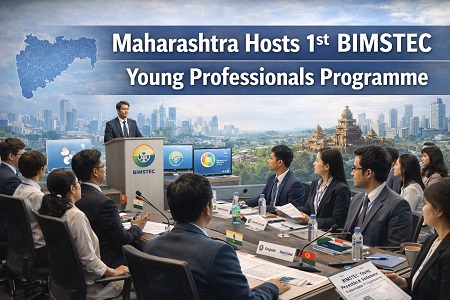
First edition held in Mumbai and Pune
The hosting of the first edition in Maharashtra gives the programme both diplomatic and economic significance. The Ministry of External Affairs said the exchange programme was organised by the MEA in partnership with the Government of Maharashtra. The choice of Mumbai and Pune placed the participants inside two of India’s most visible knowledge, finance, technology and higher-education centres. That gave the week-long programme a practical setting rather than only a conference-style format.
Official details released by the ministry show that the programme ran for seven days and included institutional visits, interactions with leaders and exposure to sectors that shape India’s growth model. The structure suggests that the initiative was designed not simply as a ceremonial youth gathering, but as a curated regional exchange linking innovation, entrepreneurship, public institutions and cross-border networking.
In a regional grouping where connectivity discussions often focus on trade, transport, security and diplomacy, this programme shifted attention toward younger professionals and future-facing sectors. That is what makes Maharashtra’s role important in this story. The state was not just a venue host. It served as the operational platform for the first edition of a programme that India has positioned as part of a wider BIMSTEC youth-engagement effort.
What the programme was meant to achieve
The Ministry of External Affairs said the programme was aimed at promoting knowledge exchange, strengthening cooperation and providing exposure to India’s innovation, start-up, knowledge, research and technology ecosystem. Those objectives place the initiative firmly in the category of practical regional engagement. Rather than focusing only on speeches and declarations, the exchange programme was built around direct interaction with institutions, professionals and systems that participants could observe first-hand.
This is a notable shift in the way regional cooperation is being framed. Youth initiatives are often described in broad terms, but the Maharashtra programme was structured around specific professional and institutional exposure. That matters because it gives the programme a more applied character. Young entrepreneurs, developers and innovators are not only being introduced to one another; they are also being connected to operating models, business environments, policy institutions and technology ecosystems that may influence future collaboration.
The broader message from the Indian side is that sustained regional cooperation requires networks beyond formal diplomacy. By bringing together emerging professionals from across the Bay of Bengal region, the initiative appears intended to build long-term contacts that can later translate into business links, innovation partnerships, institutional exchanges and research cooperation.
Announced during the 6th BIMSTEC Summit
The programme did not emerge in isolation. The MEA said it had been announced by Prime Minister Narendra Modi during the 6th BIMSTEC Summit, as part of India’s commitment to strengthen engagement among the young people of the Bay of Bengal region. A PIB release issued after the summit said India would launch the BIMSTEC Hackathon and the Young Professional Visitors programme as part of its youth-engagement agenda within BIMSTEC.
That summit-level connection is important because it shows the Maharashtra event as part of a formal regional roadmap rather than a stand-alone state-hosted initiative. The sixth summit, held in 2025, laid out a broad list of India-backed proposals across business, training, technology, youth engagement, sports and culture. Within that larger package, the young professionals programme represented one of the concrete youth-facing initiatives expected to move from announcement to implementation.
The fact that the first edition has now been hosted in Maharashtra gives the initiative an implementation milestone. In policy terms, that changes the story from a summit proposal to a delivered programme. It also suggests that youth and professional exchanges are becoming more visible instruments in BIMSTEC’s evolving cooperation agenda.
Who took part in the programme
According to the official MEA release, the exchange programme brought together 30 participants from BIMSTEC member countries. The ministry described them as young innovators, technology developers, entrepreneurs and other professionals. That description is important because it indicates the programme was not limited to student delegates or purely diplomatic youth representatives. It was aimed at people already working in fields tied to innovation, enterprise and applied knowledge.
BIMSTEC itself consists of seven member states: Bangladesh, Bhutan, India, Myanmar, Nepal, Sri Lanka and Thailand. The MEA’s official brief describes the grouping as a bridge between South Asia and Southeast Asia, noting that it brings together 1.7 billion people, or about 22 percent of the world’s population, with a combined GDP of US$5 trillion. That broader scale helps explain why youth and professional exchanges are being treated as strategically significant. The region is not a small diplomatic forum. It is a large and economically important subregional grouping.
By focusing on participants with backgrounds in technology, entrepreneurship and innovation, the first Maharashtra edition appears to have been designed to match the direction in which BIMSTEC cooperation is increasingly moving: toward start-ups, digital systems, practical training and cross-border networks that go beyond formal state channels.
What participants saw in Maharashtra
The Ministry of External Affairs said the delegates visited a number of major Indian institutions during the programme. These included the Indian Institute of Technology Bombay, the Jawaharlal Nehru Port Authority, the Bharat Diamond Bourse, the National Stock Exchange, Infosys and Symbiosis. The ministry said these visits gave participants an opportunity to interact with industry leaders and understand how major institutions contribute to innovation and economic growth in India.
The range of visits is notable in itself. IIT Bombay represents research and higher education. Jawaharlal Nehru Port Authority points to maritime trade and logistics. The National Stock Exchange reflects financial systems and capital markets. Infosys brings in the technology and services economy. Symbiosis adds the academic and training dimension. Taken together, the itinerary suggests a deliberate attempt to present participants with a multi-sector picture of how India’s growth ecosystem functions.
This also helps explain why Mumbai and Pune were chosen. The two cities offered access to finance, higher education, logistics, industry, technology and entrepreneurship within a single host state. That made Maharashtra a suitable venue for a programme designed to introduce participants to interconnected parts of India’s development model rather than one single sector.
Interaction with Maharashtra Chief Minister
During the programme, participants also called on Maharashtra Chief Minister Devendra Fadnavis. DD News reported that the chief minister highlighted Maharashtra’s knowledge, innovation and technology ecosystem and its potential as a platform for international partnerships. This detail matters because it shows the state government positioning Maharashtra not only as a domestic growth centre, but also as a possible regional collaboration platform for professionals from BIMSTEC countries.
The interaction also underlined one of the main political messages around the programme: Maharashtra was being presented as a gateway through which young professionals from neighboring BIMSTEC countries could engage with India’s educational, financial, technological and industrial institutions. That gives the event a dual role. It functioned as a BIMSTEC regional initiative, while also allowing Maharashtra to showcase its own economic and institutional strengths to a regional audience.
In news terms, that meeting added a state-level political dimension to a programme that was otherwise coordinated by the Ministry of External Affairs. It showed how subnational platforms are being used to support regional diplomacy and professional exchange.
Why this matters in the BIMSTEC context
The larger significance of the programme lies in the direction it signals for BIMSTEC cooperation. The grouping has traditionally been discussed in terms of trade, connectivity, security, energy and diplomacy. But recent summit documents and official briefs show increasing emphasis on people-to-people contact, youth engagement, training and innovation. The sixth BIMSTEC Summit declaration expressed commitment to enhancing BIMSTEC’s visibility through public awareness programmes, youth engagements, cultural events and sports among member states.
That is why the Maharashtra programme matters beyond the immediate event calendar. It reflects a broader attempt to institutionalise youth-facing and professional exchanges as part of regional cooperation. For India, this fits with the official language used by the MEA, which linked the initiative to the country’s Neighbourhood First and Act East policies. The ministry said such platforms are important for allowing young professionals, entrepreneurs and innovators to interact, learn from one another and build long-term partnerships.
The framing is strategic. BIMSTEC sits at the intersection of South Asia and Southeast Asia, and India has been steadily trying to deepen the grouping’s practical relevance. Programmes like this one help translate regional diplomacy into professional networks and visible exchanges with identifiable participants and institutions.
From summit language to implementation
One of the clearest takeaways from the first Maharashtra edition is that a summit announcement has now moved into implementation. The 2025 summit signaled intent. The 2026 programme provided a working model. That progression is important in regional organisations, where many initiatives are announced but fewer move quickly into visible, structured delivery.
The first edition also provides a template for what future rounds might look like. The combination of institutional visits, state-government engagement, interactions with industry and exposure to innovation ecosystems offers a format that could be repeated or expanded in later editions. Whether the programme grows into an annual fixture or evolves into a wider network-building initiative, the Maharashtra event now serves as its first practical benchmark.
It also arrives at a time when BIMSTEC has been broadening its cooperation agenda. Official Indian briefs note recent initiatives ranging from youth summits and climate conferences to sports events and training programmes. In that setting, the young professionals exchange programme adds another layer to the regional architecture by focusing on emerging professionals rather than only officials or students.
What the first edition signals
The immediate outcome of the programme is straightforward: India has hosted the first edition, Maharashtra served as the venue, and delegates from BIMSTEC member countries participated in a structured week of institutional and professional exposure. But the larger meaning lies in what this may build over time. Regional cooperation today is shaped not only by diplomatic agreements, but also by networks of researchers, founders, developers, professionals and institutions that remain in contact after official events end.
The MEA said the initiative would help strengthen regional ties, foster innovation and build lasting networks among emerging leaders across the BIMSTEC region. That line captures the central purpose of the programme. The Maharashtra edition was not presented as an isolated youth event. It was framed as a platform for regional relationship-building among people likely to shape future technology, enterprise and knowledge partnerships in the Bay of Bengal region.
For now, the headline is simple: Maharashtra has hosted the first BIMSTEC Young Professionals Exchange Programme. The details behind it show a wider regional story about how India and BIMSTEC are trying to turn youth engagement into an operational part of regional cooperation.