
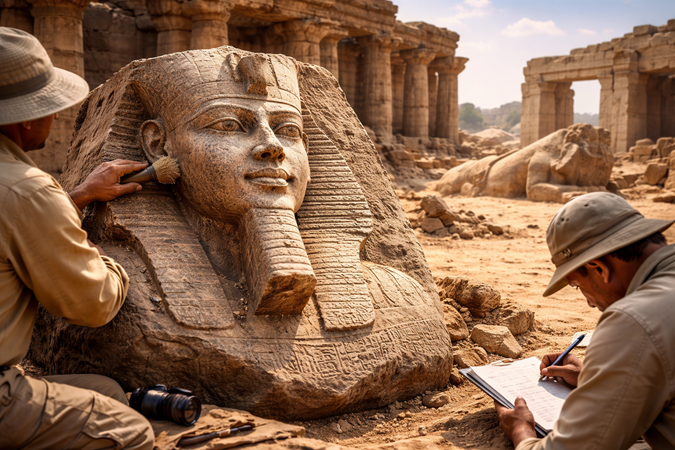
18 March 2026: Hermopolis Magna, Egypt – Archaeologists have uncovered a significant fragment of a statue believed to depict Ramesses II at the ancient Egyptian site of Hermopolis Magna. The discovery adds to the growing body of evidence highlighting the historical and cultural significance of one of ancient Egypt’s most prominent pharaohs.
About Ramesses II
Ramesses II, also known as Ramesses the Great, is widely regarded as one of ancient Egypt’s most powerful and influential rulers. His reign is often associated with extensive building projects, military campaigns, and diplomatic achievements.
He is credited with constructing numerous temples, monuments, and statues across Egypt, many of which continue to stand as iconic symbols of ancient Egyptian civilization. His legacy includes the famous temples of Abu Simbel and the Ramesseum.
Details of the Discovery
The fragment discovered at Hermopolis Magna is made of limestone and features intricate carvings that are consistent with artistic styles from the New Kingdom period. Archaeologists have identified elements of royal iconography, including portions of the headdress and inscriptions that are believed to reference Ramesses II.
The size and craftsmanship of the fragment suggest that it was part of a large statue, possibly erected in a temple or public space. Experts are currently conducting detailed analyses to determine the original dimensions and purpose of the statue.
“The discovery of this fragment provides valuable insight into the artistic and cultural practices of the time,” said a member of the excavation team. “It also helps us better understand the extent of Ramesses II’s influence in this region.”
Significance of Hermopolis Magna
Hermopolis Magna, located in Middle Egypt, was an important religious and cultural center in ancient times. The city was dedicated to Thoth, the god of wisdom, writing, and knowledge.
The site has yielded numerous archaeological findings over the years, including temples, inscriptions, and artifacts that provide insights into ancient Egyptian religion and daily life. The discovery of a statue fragment associated with Ramesses II further enhances the historical importance of the site.
Archaeological Importance
The discovery is considered significant for several reasons. It contributes to the understanding of the distribution of Ramesses II’s monuments and offers new data for researchers studying the New Kingdom period.
Archaeologists emphasize that such findings help reconstruct historical narratives and provide context for the political and cultural dynamics of ancient Egypt. The fragment may also offer clues about the architectural layout of structures that once existed at the site.
Ongoing Research and Conservation
Following the discovery, the fragment has been carefully documented and secured for further study. Conservation efforts are underway to preserve the artifact and prevent deterioration.
Advanced techniques, including 3D scanning and digital reconstruction, are expected to be used to analyze the fragment and potentially recreate the original statue. Researchers are also exploring the surrounding area for additional fragments that may be part of the same structure.
Expert Reactions
Historians and Egyptologists have welcomed the discovery, noting its importance in expanding knowledge about one of ancient Egypt’s most influential periods.
“Each new finding related to Ramesses II adds depth to our understanding of his reign and its impact,” said an Egyptologist. “Discoveries like this are crucial for piecing together the history of ancient civilizations.”
Global Interest in Egyptian Archaeology
Egypt continues to be a focal point for archaeological research, attracting teams from around the world. Recent discoveries have generated global interest, highlighting the country’s rich cultural heritage.
The ongoing exploration of ancient sites is expected to yield further discoveries, contributing to academic research and cultural preservation efforts.
Future Prospects
Archaeologists plan to continue excavations at Hermopolis Magna, with the aim of uncovering more artifacts that could provide additional context for the statue fragment. The findings are expected to be shared with the global academic community through research publications and exhibitions.
The discovery underscores the enduring importance of archaeological research in uncovering the history of ancient civilizations and preserving it for future generations.